
Standards and Regulatory Publications — WASL — Pakistan National Data Exchange Layer: Technical Specification
Summary
This Technical Specification defines the concrete protocol bindings, API endpoint specifications, message envelope formats, token structures, metadata record schemas, consent policy formats, data-classification technical controls, error codes and conformance test requirements for WASL, Pakistan's National Data Exchange Layer. It is the implementer reference for building conformant WASL Client Nodes and platform integrations, subordinate to DNP-D.002 RA.
| Document reference | DNP-D.300 TS |
|---|---|
| Title | WASL — Pakistan National Data Exchange Layer: Technical Specification |
| Document type | Technical Specification (TS) |
| Status | Working Draft (WD) |
| Maturity level | PILOT |
| Version | 0.1 |
| Date | 26 April 2026 |
| Classification | PUBLIC |
| Published by | Pakistan Digital Authority |
| Persistent URL | https://standards.dnp.gov.pk/DNP-D.300 |
| URN | urn:dnp:D:300:TS:0.1:en |
| DOI | https://doi.org/10.83282/dnp-d-300-ts |
| Gazette reference | N/A |
Document Control
| Version | Date | Description | Approved by |
|---|---|---|---|
| 0.1 | 26 April 2026 | Initial publication |
Foreword
The Pakistan Digital Authority (PDA) is the statutory body established under the Digital Nation Pakistan Act, 2025, mandated to issue standards, frameworks, and technical publications in support of the National Digital Masterplan.
WASL — Pakistan's National Data Exchange Layer, is a foundational component of the country's Digital Public Infrastructure. It enables secure, consent-governed, standardized data exchange between federal and provincial entities, regulated private-sector institutions, and authorized platforms, while preserving federated data custody and cryptographic privacy by design.
This technical specification defines the concrete implementation requirements for WASL. It provides the protocol bindings, API specifications, message formats, and conformance test requirements that implementers require to build WASL-conformant systems. It is subordinate to DNP-D.002 RA (WASL Reference Architecture) and shall be read in conjunction with it. It is being issued at PILOT maturity; revision cycles are expected to follow as implementation experience accumulates.
This specification is developed to be approved by the PDA Standards Board under the procedures defined in DNP-X.001 FWK (Nomenclature, Series Structure & Issuance Framework).
1 SCOPE
This technical specification defines the implementation requirements for WASL, Pakistan's National Data Exchange Layer. It provides the protocol bindings, API endpoint specifications, request and response envelope formats, token structures, metadata record schemas, consent policy formats, data classification technical controls, error codes, and conformance test requirements that together constitute the implementer reference for WASL.
It applies to:
- all entities implementing WASL Client Nodes, whether as data consumers, data providers, or both;
- all vendors and system integrators supplying WASL-conformant software, services, or components to participating entities or to PDA;
- all implementations of the Central WASL Platform, WASL Client Nodes, and the Secure Connectivity Layer intended for use in the WASL production ecosystem or in certified sandbox environments.
This specification does not govern:
- the architectural philosophy, design principles, and component model of WASL, these are defined in DNP-D.002 RA (WASL Reference Architecture), to which this specification is subordinate;
- the internal information systems, databases, APIs, or business logic of participating organizations, except insofar as those systems must conform to published WASL schemas and fulfilment layer requirements;
- the legal, regulatory, and mandatory participation rules governing entities that must transact over WASL, these will be issued separately as a Regulation (REG) under the DNP-D series;
- sector-specific data sharing rules and field-level schema extensions, will be issued as sectoral Profiles (PRF) under the appropriate DNP-D sub-series;
2 REFERENCES
The following references are indispensable for the application of this specification. For dated references, only the edition cited applies. For undated references, the latest edition of the referenced document applies.
2.1 Normative References — National
- Pakistan Security Standards for Cryptographic and Information Technology Security Devices.
2.2 Normative References — International
- IETF RFC 2119 — Key words for use in RFCs to Indicate Requirement Levels.
- IETF RFC 8174 — Ambiguity of Uppercase vs Lowercase in RFC 2119 Key Words.
- IETF RFC 6749 — The OAuth 2.0 Authorization Framework.
- IETF RFC 7519 — JSON Web Token (JWT).
- IETF RFC 7517 — JSON Web Key (JWK).
- IETF RFC 7518 — JSON Web Algorithms (JWA).
- IETF RFC 8446 — The Transport Layer Security (TLS) Protocol Version 1.3.
- IETF RFC 8705 — OAuth 2.0 Mutual-TLS Client Authentication and Certificate-Bound Access Tokens.
- IETF RFC 9110 — HTTP Semantics.
- OpenID Foundation — OpenID Connect Core 1.0.
- OAuth 2.1 Authorization Framework (draft-ietf-oauth-v2-1, latest).
- OpenAPI Specification v3.0.
- JSON Schema Specification (Draft 2020-12).
- ISO/IEC 27001 — Information security management systems — Requirements.
- ISO/IEC 27018 — Code of practice for protection of PII in public clouds.
- ISO/IEC 29100 — Privacy framework.
- NIST SP 800-207 — Zero Trust Architecture.
- FIPS 186-5 — Digital Signature Standard (DSS), NIST.
- FIPS 140-2/3 — Security Requirements for Cryptographic Modules, NIST.
- Protocol Buffers Language Guide (proto3), Google — applicable where gRPC transport is used.
2.3 Informative References
- Universal DPI Safeguards Framework, UNDP / Office of the UN Secretary-General's Envoy on Technology, 2023.
- G20 Framework for Digital Public Infrastructure, 2023.
- Estonia X-Road Technical Specification (reference implementation).
- European Interoperability Framework (EIF), European Commission.
3 DEFINITIONS
For the purposes of this specification, the following definitions apply. Definitions are listed alphabetically.
| Term | Definition |
|---|---|
| 3.1 Access Token | A short-lived JWT credential issued by the WASL IAM Token Endpoint to an authenticated Client Node. Encodes the requesting entity's identity, permitted scopes, and declared purpose. |
| 3.2 Central WASL Platform | The shared national control-plane and routing-plane operated by NADRA and owned by the Pakistan Digital Authority, providing identity management, metadata discovery, consent orchestration, API governance, routing, audit, and transaction proof recording. |
| 3.3 Client Node | A containerized software component deployed within a participating entity's infrastructure that performs all cryptographic operations (signing, verification, encryption, decryption) and mediates the entity's participation in WASL data exchange. |
| 3.4 Conformance Test | A defined procedure that verifies whether a specific implementation satisfies one or more normative requirements of this specification. Conformance tests are expressed as observable, repeatable, and automatable where possible. |
| 3.5 Consent | An explicit, verifiable, revocable authorization granted by a natural person through an approved consent channel for the exchange of personal data concerning that person, for a specified purpose and duration. |
| 3.6 Consent Artifact | A signed JSON object produced by the WASL Consent Layer upon citizen approval of a data sharing request, containing the consent identifier, subject identifier, consumer and provider identifiers, dataset and field scope, declared purpose, validity window, channel, and a WASL platform digital signature. |
| 3.7 Consumer | A participating entity that requests data through WASL for a defined and authorized purpose. |
| 3.8 Data Blindness | The architectural property whereby the Central WASL Platform handles only encrypted payloads and is cryptographically prevented from reading the content of exchanged data, while retaining cryptographic proof that an exchange occurred. |
| 3.9 Data Exchange Plane | The functional layer of WASL responsible for secure routing, protocol mediation, orchestration, and transaction lifecycle management between Consumer and Provider Client Nodes. |
| 3.10 Federated Data Ownership | The principle whereby each participating entity retains custody, control, and serving responsibility for its own data and private keys, with WASL performing routing and control-plane functions only. |
| 3.11 Fulfilment Layer | The sub-component of the Provider Client Node that receives inbound getData requests, performs all verification steps, retrieves data from internal backend systems, validates responses against the published schema, signs the response, and submits the provider-side TPL proof record. |
| 3.12 Metadata Repository | The authoritative control-plane registry maintaining machine-readable dataset definitions, schemas, provider bindings, consent policies, and classification rules for the WASL ecosystem. |
| 3.13 mTLS | Mutual Transport Layer Security. A mode of TLS in which both the client and server present certificates for mutual authentication. Required for all WASL Client Node to platform connections. |
| 3.14 PAK-ID | Pakistan's national digital identity platform operated by or in coordination with NADRA, used by WASL for citizen authentication and consent acquisition. |
| 3.15 Participating Entity | A federal, provincial, or regulated private-sector organization formally onboarded to WASL as a Consumer, Provider, or both, under a duly executed participation agreement. |
| 3.16 Provider | A participating entity that holds authoritative source data in its systems and serves that data through WASL in response to authorized and consent-verified requests. |
| 3.17 Request Envelope | The standardized JSON structure that wraps all WASL getData requests, containing the transaction identifier, dataset identifier, schema version, subject identifier, declared purpose, consent reference, requester identity, timestamp, and consumer digital signature. |
| 3.18 Response Envelope | The standardized JSON structure that wraps all WASL getData responses, containing the transaction identifier, status code, provider identifier, data payload, timestamp, provider digital signature, and TPL proof reference. |
| 3.19 Secure Connectivity Layer | The network-level component of the Central WASL Platform responsible for encrypted routing of payloads between Consumer and Provider Client Nodes. |
| 3.20 Token Endpoint | The IAM-hosted endpoint to which a WASL Client Node submits credentials to obtain an OAuth 2.1 access token for use in WASL API calls. |
| 3.21 Transaction Proof Layer (TPL) | The component of the Central WASL Platform that records cryptographic proofs of each transaction (hashes, signatures, timestamps) without recording transaction content. |
| 3.22 Verifiable Credential (VC) | A tamper-evident, cryptographically signed digital credential conforming to the W3C Verifiable Credentials Data Model; issuance and lifecycle are governed under the DNP-U series and are outside the scope of this specification. |
| 3.23 WASL | Pakistan's National Data Exchange Layer, the subject of this specification. The name is rendered in Urdu as وصل, meaning connection or linkage. |
| 3.24 Zero-Knowledge Proof (ZKP) | A cryptographic method by which one party can prove to another that a statement is true without revealing any information beyond the validity of the statement itself. 3.25 AI Agent: A software system that uses an artificial intelligence model to autonomously plan, decide, or execute actions, including actions that invoke WASL APIs. An AI Agent may operate on behalf of an institution or, under a delegated consent artefact (v2 capability), on behalf of a citizen. For WASL authentication purposes, an AI Agent is an authorized Consumer application subject to the additional identity binding requirements in Section 24.1. |
| 3.26 Client Category | A risk-based classification assigned to each Participating Entity at onboarding determining private key protection requirements. Four categories are defined in section |
| 3.27 Cryptographic Agility | The architectural property whereby cryptographic algorithms, key sizes, and protocol parameters can be updated or replaced without redesigning the system. Implemented in WASL through the Cryptographic Parameter Registry and per-session algorithm negotiation per Section 14.3a. |
| 3.28 Cryptographic Parameter Registry | The sub-component of the Metadata Repository publishing permitted cryptographic algorithm suites, minimum key sizes, and deprecation schedules. Client Nodes retrieve and cache these parameters for per-session algorithm negotiation and PQC migration. |
| 3.29 Model Context Protocol (MCP) | An open protocol standardizing how AI applications connect to external data sources and tools. WASL exposes an MCP server surface through the Developer Portal (Section 24.3). |
| 3.30 Post-Quantum Cryptography (PQC) | Cryptographic algorithms designed to remain secure against adversaries with access to cryptographically-relevant quantum computers. WASL mandates cryptographic agility to enable migration to NIST-standardized PQC algorithms (ML-KEM / FIPS 203, ML-DSA / FIPS 204, SLH-DSA / FIPS 205) per Section 14.3a. |
4 ABBREVIATIONS
| Abbreviation | Definition |
|---|---|
| API | Application Programming Interface |
| CA | Certificate Authority |
| CNIC | Computerized National Identity Card |
| CRL | Certificate Revocation List |
| DCS | Department of Communications Security |
| DNP | Digital Nation Pakistan |
| DPI | Digital Public Infrastructure |
| FIPS | Federal Information Processing Standard |
| gRPC | Google Remote Procedure Call |
| HMAC | Hash-based Message Authentication Code |
| HSM | Hardware Security Module |
| IAM | Identity and Access Management |
| IPSec | Internet Protocol Security |
| JWA | JSON Web Algorithms |
| JWK | JSON Web Key |
| JWS | JSON Web Signature |
| JWT | JSON Web Token |
| mTLS | Mutual Transport Layer Security |
| NADRA | National Database and Registration Authority |
| NDEL | National Data Exchange Layer |
| NIST | National Institute of Standards and Technology |
| NTN | National Tax Number |
| OCSP | Online Certificate Status Protocol |
| OIDC | OpenID Connect |
| PDA | Pakistan Digital Authority |
| PEP | Policy Enforcement Point |
| PKI | Public Key Infrastructure |
| RBAC | Role-Based Access Control |
| REST | Representational State Transfer |
| RFC | Request for Comments |
| TLS | Transport Layer Security |
| TPL | Transaction Proof Layer |
| TSA | Timestamping Authority |
| VC | Verifiable Credential |
| VPN | Virtual Private Network |
| WASL | Pakistan's National Data Exchange Layer |
| WAF | Web Application Firewall |
| ZKP | Zero-Knowledge Proof |
5 PROTOCOL BINDINGS
This section specifies the concrete protocol bindings that all WASL-conformant implementations SHALL support. Key words (SHALL, MUST, SHOULD, MAY) are used in accordance with IETF RFC 2119 / RFC 8174.
5.1 Transport Security: TLS 1.3
All communications within the WASL ecosystem SHALL use TLS 1.3 as defined in IETF RFC 8446. TLS 1.2 MAY be used only where TLS 1.3 is not supported by existing infrastructure and only with explicit PDA exemption. TLS 1.1 and earlier are prohibited.
5.1.1 Mandatory TLS 1.3 Cipher Suites
| Cipher Suite | IANA Code | Requirement |
|---|---|---|
| TLS_AES_256_GCM_SHA384 | 0x1302 | REQUIRED |
| TLS_CHACHA20_POLY1305_SHA256 | 0x1303 | REQUIRED |
| TLS_AES_128_GCM_SHA256 | 0x1301 | RECOMMENDED |
5.1.2 Certificate Requirements
All TLS certificates used in WASL SHALL: be issued by the WASL-recognized PKI Certificate Authority; conform to X.509 version 3; use RSA-4096 or ECDSA P-256/P-384 key pairs; have a maximum validity period of 24 months for entity signing certificates and for VPN device certificates; include appropriate Key Usage and Extended Key Usage extensions; and support OCSP stapling.
5.2 Mutual TLS (mTLS) Binding
All WASL Client Node to Central Platform connections SHALL use mTLS as specified in IETF RFC 8705. Both client and server MUST present valid X.509 certificates issued by the WASL PKI. Certificate validation SHALL include: chain verification to the WASL Root CA; revocation checking via OCSP (preferred) or CRL; hostname verification against the registered entity endpoint; and certificate expiry validation.
NOTE: mTLS is enforced at the application transport layer above the IPSec VPN tunnel, providing defence in depth. Failure of mTLS validation MUST result in connection termination with no data exchanged.
5.2.1 mTLS Client Certificate Binding to OAuth Token
When mTLS client authentication is used with OAuth 2.1, the access token SHALL be bound to the client certificate per RFC 8705 Section 3. The token endpoint SHALL include the SHA-256 thumbprint (x5t#S256) of the client certificate in issued tokens. The API Gateway SHALL verify that the presented client certificate matches the thumbprint in the access token.
// Certificate thumbprint binding in JWT (cnf claim)
{
  "sub": "org:punjab_education_dept",
  "cnf": {"x5t#S256": "bwDkHGl3JzRrVF1AkOhQdS7Pc_q3EjFEUKuLb2xKH88"},
  "scope": "data.fetch consent.read",
  "exp": 1746000000
}
5.3 OAuth 2.1 Binding
WASL IAM implements OAuth 2.1 (draft-ietf-oauth-v2-1). The client credentials grant with private_key_jwt client authentication is the mandatory grant for all automated Client Node to platform interactions.
5.3.1 Token Request
POST /oauth2/token HTTP/1.1
Host: iam.wasl.gov.pk
Content-Type: application/x-www-form-urlencoded
grant_type=client_credentials
&client_assertion_type=urn:ietf:params:oauth:client-assertion-type:jwt-bearer
&client_assertion=<signed-JWT>
&scope=data.fetch+consent.read
5.3.2 Token Endpoint Parameters
| Parameter | Type | Required | Description |
|---|---|---|---|
| grant_type | string | REQUIRED | MUST be client_credentials |
| client_assertion_type | string | REQUIRED | MUST be urn:ietf:params:oauth:client-assertion-type:jwt-bearer |
| client_assertion | string | REQUIRED | Signed JWT asserting client identity |
| scope | string | REQUIRED | Space-separated list of requested scopes |
5.3.3 Supported Scopes
| Scope | Permits | Restriction |
|---|---|---|
| data.fetch | Invoke getData API | Requires dataset subscription and consent where applicable |
| data.schema.read | Invoke getSchema and listDatasets APIs | All registered entities |
| consent.read | Invoke getConsentInfo API | Consumer and subject entities only |
| consent.write | Submit consent decisions; invoke revokeConsent | Consent Layer and authorised entities |
| tpl.query | Invoke getTransactionTPLStatus API | Parties to the transaction only |
| metadata.admin | Publish/update metadata records | PDA and approved domain custodians only |
5.4 OpenID Connect (OIDC) Binding
WASL IAM supports OIDC 1.0 for citizen-facing authentication and consent flows via PAK-ID integration. The authorization_code flow with PKCE MUST be used for all user-facing interactions. The implicit flow is prohibited. The OIDC discovery document is published at: https://iam.wasl.gov.pk/.well-known/openid-configuration
5.5 IPSec VPN Binding
All participating entities SHALL establish site-to-site IPSec VPN tunnels to the WASL Secure Connectivity Layer prior to production participation.
| Parameter | Required Value |
|---|---|
| IKE Version | IKEv2 (RFC 7296) |
| Authentication Method | Certificate-based (X.509 issued by WASL PKI) |
| Encryption Algorithm | AES-256-GCM |
| Integrity Algorithm | SHA-384 or SHA-512 |
| Diffie-Hellman Group | Group 19 (ECDH P-256) or Group 20 (ECDH P-384) — minimum |
| Perfect Forward Secrecy | Required — rekey interval not to exceed 8 hours |
| Tunnel Mode | Site-to-site (not transport mode) |
| Dead Peer Detection | Required — interval: 30s, timeout: 120s |
6 IDENTITY AND ACCESS MANAGEMENT: TECHNICAL SPECIFICATION
The Identity and Access Management (IAM) component is the trust anchor of the WASL ecosystem, responsible for establishing and enforcing identity, authentication, and authorization across all participating entities. IAM enables secure machine-to-machine and user-mediated interactions by issuing verifiable access tokens, enforcing access policies, and integrating with national identity systems such as PAK-ID. It ensures that every request entering the WASL ecosystem is attributable, authorized, and cryptographically verifiable.
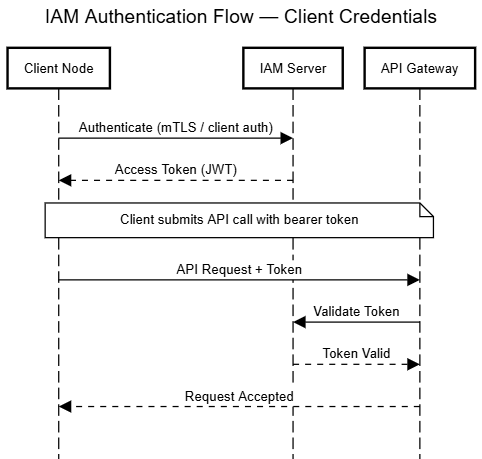
Figure 6-1: IAM Authentication Flow — OAuth 2.1 client credentials with mTLS client authentication
The IAM component performs the following core functions:
- Registration and identity lifecycle management for participating organizations.
- Client application registration and credential issuance.
- OAuth 2.1 token issuance and validation using the client_credentials flow with private_key_jwt client assertions.
- OpenID Connect (OIDC) supports citizen identity federation via PAK-ID.
- Role-based and attribute-based access control enforcement (consumer, provider, administrator).
- Token introspection, revocation, and expiry enforcement including JTI replay prevention.
- Secure binding of organizational identities to PKI-issued cryptographic credentials.
WASL IAM follows a zero-trust, token-based security model where every request must be authenticated and authorized independently. Authentication uses Mutual TLS (mTLS) for client-node authentication combined with the OAuth 2.1 client credentials flow for machine-to-machine communication. Authorization is enforced using OAuth scopes, role-based access control (RBAC), and attribute-based policies derived from the Metadata Repository and Consent Layer. No implicit trust exists between participants; all interactions are explicitly verified before any data exchange proceeds.
6.1 IAM Endpoints
| IAM Endpoint | URI | Protocol |
|---|---|---|
| Token Endpoint | https://iam.wasl.gov.pk/oauth2/token | OAuth 2.1 |
| JWKS URI | https://iam.wasl.gov.pk/.well-known/jwks.json | JWK (RFC 7517) |
| Introspection Endpoint | https://iam.wasl.gov.pk/oauth2/introspect | RFC 7662 |
| Revocation Endpoint | https://iam.wasl.gov.pk/oauth2/revoke | RFC 7009 |
| OIDC Discovery | https://iam.wasl.gov.pk/.well-known/openid-configuration | OIDC 1.0 |
| Client Registration | https://iam.wasl.gov.pk/register | RFC 7591 |
6.2 JWT Access Token Structure
WASL IAM issues JSON Web Tokens as access tokens. All tokens SHALL be signed using ES256 (ECDSA with P-256 and SHA-256) or RS256. The signing key MUST be stored in an HSM conforming to FIPS 140-2/3 Level 3 or above.
6.2.1 JWT Header
{
  "alg": "ES256",
  "typ": "JWT",
  "kid": "wasl-iam-signing-key-2026-01"
}
6.2.2 JWT Payload — Complete Claim Set
{
  "iss": "https://iam.wasl.gov.pk",
  "sub": "org:bank_alfalah",
  "aud": ["https://api.wasl.gov.pk"],
  "scope": "data.fetch consent.read",
  "org_id": "bank_alfalah",
  "org_type": "financial_institution",
  "client_id": "loan_app_01",
  "purpose": "credit_assessment",
  "roles": ["consumer"],
  "dataset_subscriptions": ["income.tax", "civil.registry.basic"],
  "iat": 1746000000,
  "exp": 1746000900,
  "nbf": 1746000000,
  "jti": "7f3d4a21-8b9c-4e1f-a2d3-5c6e7f8a9b0c",
  "cnf": {"x5t#S256": "bwDkHGl3JzRrVF1AkOhQdS7Pc_q3EjFEUKuLb2xKH88"}
}
6.2.3 JWT Claim Definitions
| Claim | Type | Required | Description |
|---|---|---|---|
| iss | string (URI) | REQUIRED | Issuer. MUST be https://iam.wasl.gov.pk |
| sub | string | REQUIRED | Subject. Format: org:<entity_id> for entity tokens |
| aud | string[] | REQUIRED | Audience. MUST include https://api.wasl.gov.pk |
| scope | string | REQUIRED | Space-separated list of granted scopes |
| org_id | string | REQUIRED | Registered WASL entity identifier |
| org_type | string | REQUIRED | government | financial_institution | regulated_private | platform |
| client_id | string | REQUIRED | Registered client application identifier |
| purpose | string | REQUIRED | Declared purpose code from the Purpose Code Registry |
| roles | string[] | REQUIRED | WASL roles: consumer | provider | admin |
| dataset_subscriptions | string[] | REQUIRED | List of dataset IDs the entity is subscribed to |
| iat | integer (epoch) | REQUIRED | Issued-at time |
| exp | integer (epoch) | REQUIRED | Expiry time. Maximum: iat + 900 seconds (15 minutes) |
| nbf | integer (epoch) | REQUIRED | Not-before time. SHOULD equal iat |
| jti | string (UUID v4) | REQUIRED | Unique token ID for replay prevention |
| cnf.x5t#S256 | string | REQUIRED | SHA-256 thumbprint of mTLS client certificate (RFC 8705). When the token is issued to an AI-driven application, the following additional claims SHALL be present: ai_model_id (REQUIRED for AI agents) — registered model identifier from the DNP-A model registry, format: <registry>:<model_id>:<version>; ai_invoking_principal (REQUIRED for AI agents), the human operator, service account, or orchestrating system that initiated the AI action; ai_model_version (REQUIRED for AI agents), model version string for forensic traceability. These claims are omitted (null) for standard non-AI tokens. |
| delegated_by | CONDITIONAL | REQUIRED when token_type=delegated_channel. The org_id of the WASL Participating Entity that issued the API key/secret to this delegated application. Absent for standard Participating Entity tokens. Used by the API Gateway to enforce scope and resolve the sponsoring entity’s authorisations (Section 26.2). | |
| delegation_scope | CONDITIONAL | REQUIRED when token_type=delegated_channel. Space-separated list of dataset IDs and API scopes the sponsoring entity has explicitly permitted the delegated application to access. The API Gateway SHALL reject any request where the requested operation or dataset falls outside this list, even if the sponsoring entity itself has broader subscriptions. Absence of this claim on a delegated_channel token is a token validation failure (Section 26.3). |
6.2.4 Token Validation Requirements
Resource servers SHALL validate access tokens by: verifying JWT signature against the WASL IAM JWKS public key identified by kid; verifying iss is exactly https://iam.wasl.gov.pk; verifying aud includes the resource server's registered audience URI; verifying exp is in the future (clock skew tolerance: 30 seconds); verifying jti has not been seen before (maintain JTI cache for token_lifetime + 30s); for mTLS-bound tokens, verifying the presented client certificate SHA-256 thumbprint matches cnf.x5t#S256; and verifying scope includes the required scope for the requested operation.
6.3 IAM Security Controls
| Control | Specification |
|---|---|
| Token lifetime | Maximum 900 seconds (15 minutes). Shorter lifetimes recommended for Tier 4/5 data. |
| Replay prevention | JTI uniqueness enforced. JTI cache maintained for token_lifetime + 30s. |
| Rate limiting | Maximum 60 token requests per minute per client_id. Excess returns HTTP 429. |
| IP restriction | Token endpoint accessible only from registered entity IP ranges. |
| Key rotation | IAM signing keys rotated every 90 days. Old keys retained in JWKS for 30 days post-rotation. |
| HSM requirement | All IAM private signing keys MUST reside in FIPS 140-2/3 Level 3 HSM. |
| Failure scenarios | See Table 6-2 below. |
Table 6-2: IAM Failure and Error Scenarios
| Scenario | Outcome |
|---|---|
| Invalid client credentials | Token request rejected: HTTP 401 |
| Expired token submitted to API | API request rejected: AUTH_TOKEN_EXPIRED |
| Invalid JWT signature | Request rejected: AUTH_TOKEN_INVALID |
| Unauthorized scope requested | Token issued with intersection of requested and permitted scopes |
| Token replay detected (duplicate jti) | Request blocked: AUTH_TOKEN_REPLAY |
| IAM temporarily unavailable | Retry / failover to standby IAM instance |
7 STANDARD API LAYER: ENDPOINT SPECIFICATIONS
The Standard API Layer defines the uniform interface contract through which all data exchange operations are performed within WASL. All endpoints are exposed at the API Gateway base URI: https://api.wasl.gov.pk/v1/. All requests MUST carry a valid Bearer access token, and MUST be made over mTLS connections.
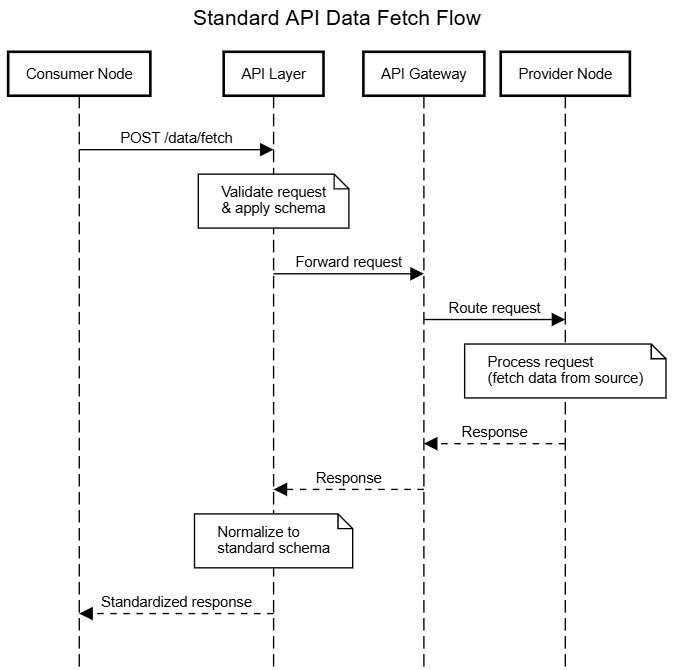
Figure 7-1: Standard API Interaction Model — consumer applications interact with provider systems through the standardised API interface mediated by the WASL platform and Client Nodes
This section specifies the Standard API Layer endpoint definitions and the API Gateway that enforces them at runtime. The Standard API Layer defines the uniform interface contract through which all data exchange operations are performed within WASL. Rather than allowing each provider to expose arbitrary APIs, WASL enforces a standardized interaction model ensuring that consumers integrate once and can interact with multiple providers, providers conform to a shared request and response structure, and platform-level controls (authentication, consent, audit, proof) are consistently enforced on every call. The Standard API Layer is governed by five principles: Uniformity (consistent API structure regardless of provider); Abstraction (consumers interact with logical datasets, not provider-specific implementations); Policy Enforcement (consent, authentication, and classification policies enforced uniformly on every call); Extensibility (supports asynchronous processing and event-driven exchange); and Interoperability (APIs defined using open standards including REST and OpenAPI v3.0). No API may bypass the WASL trust and governance framework. Standard APIs must always be used for core data exchange; custom APIs, where offered, remain subject to the same IAM, consent, and audit controls.
The API Gateway is the central runtime enforcement and routing layer for all WASL traffic. It is the single entry and exit point for all API requests, integrating with IAM, the Metadata Repository, the Consent Layer, and the Transaction Proof Layer to ensure every request is authenticated, authorized, consent-validated, schema-compliant, and auditable before being routed to any provider. It enforces rate limiting, IP allowlisting, WAF protections, and replay attack prevention. Routing is metadata-driven: the gateway resolves the correct provider's endpoint using the dataset identifier, provider availability, and load-balancing policies from the Metadata Repository.
The gateway also supports gRPC for high-throughput integrations, WebSocket connections for real-time event-streaming, and GraphQL for use cases requiring flexible, consumer-defined field selection over composite datasets published through the Custom API Marketplace. GraphQL endpoints are subject to the same IAM, consent, schema compliance, and audit controls as all other WASL API interactions; they do not provide a mechanism to bypass field-level access or consent policy enforcement.
7.1 Standard API Summary
By constraining data exchange to these standardized APIs, WASL enables consumers to integrate once against the standard interface, providers to implement a single standardized response format, and the platform to enforce consent checks, signature verification, and proof recording on every getData call.
| API Endpoint | Method | URI | Required Scope |
|---|---|---|---|
| getData | POST | https://api.wasl.gov.pk/v1/data/fetch | data.fetch |
| getSchema | GET | https://api.wasl.gov.pk/v1/schema/{datasetId} | data.schema.read |
| getConsentInfo | GET | https://api.wasl.gov.pk/v1/consent/{consentId} | consent.read |
| getTransactionTPLStatus | GET | https://api.wasl.gov.pk/v1/tpl/{transactionId} | tpl.query |
| submitConsentDecision | POST | https://api.wasl.gov.pk/v1/consent/decision | consent.write |
| revokeConsent | DELETE | https://api.wasl.gov.pk/v1/consent/{consentId} | consent.write |
| listDatasets | GET | https://api.wasl.gov.pk/v1/metadata/datasets | data.schema.read |
| getProviderStatus | GET | https://api.wasl.gov.pk/v1/providers/{providerId}/status | data.schema.read |
7.2 getData Endpoint
7.2.1 Request Specification
| Property | Value |
|---|---|
| HTTP Method | POST |
| URI | https://api.wasl.gov.pk/v1/data/fetch |
| Content-Type | application/json |
| Authorization | Bearer <access_token> |
| Required Scope | data.fetch |
| mTLS | Required |
| Max Request Size | 1 MB (encrypted payload) |
| Synchronous Timeout | 30 seconds |
| Idempotency | Not idempotent — each call creates a new transaction record in TPL |
7.2.2 HTTP Request Headers
| Header | Required | Description |
|---|---|---|
| Authorization | REQUIRED | Bearer <JWT access token> |
| Content-Type | REQUIRED | application/json |
| X-WASL-Transaction-ID | REQUIRED | Consumer-generated UUID v4. Used for idempotency tracking and TPL recording. |
| X-WASL-Request-Timestamp | REQUIRED | ISO 8601 UTC timestamp. Max skew vs server time: 5 minutes. |
| X-WASL-Signature | REQUIRED | Base64url-encoded consumer digital signature over canonical request body. |
| X-WASL-API-Version | OPTIONAL | Requested API version. Defaults to current stable version if omitted. |
| Accept | OPTIONAL | application/json (default); application/jose+json for JWE-wrapped responses. |
7.3 Custom API Marketplace and Developer Portal
While the Standard API Layer defines the mandatory baseline for data exchange, the Custom API Marketplace provides a controlled innovation layer enabling participating organizations to expose domain-specific APIs beyond the standard schema, such as composite eligibility workflows, credit-scoring services, or sector-specific processing, while remaining within the WASL trust, IAM, consent, and audit framework. All custom APIs must be registered in the Metadata Repository, conform to WASL authentication and authorization standards, enforce consent requirements where applicable, and produce auditable transactions. Custom APIs are categorized as Public (accessible to all authorized participants), Restricted (requiring approval), or Private (bilateral use only). Publication is subject to PDA governance and approval to prevent fragmentation.
The Developer Portal provides a self-service environment for: discovering available datasets and custom APIs; accessing schema definitions and documentation; registering applications and generating OAuth credentials; testing integrations in the certified sandbox environment; and managing API subscriptions and usage monitoring. The sandbox allows organizations to complete full integration testing, including consent flow validation, signature verification, and failure scenario handling, before production activation.
8 REQUEST AND RESPONSE ENVELOPE FORMATS
8.1 getData Request Envelope: JSON Schema
{
  "$schema": "https://json-schema.org/draft/2020-12/schema",
  "$id": "https://schemas.wasl.gov.pk/v1/request-envelope.json",
  "title": "WASL getData Request Envelope",
  "type": "object",
  "required": ["transactionId","datasetId","schemaVersion","subject",
               "purpose","requester","timestamp","signature"],
  "additionalProperties": false,
  "properties": {
    "transactionId": {"type": "string", "format": "uuid"},
    "datasetId": {
      "type": "string",
      "pattern": "^[a-z][a-z0-9]*\\.[a-z][a-z0-9._-]*$"
    },
    "schemaVersion": {"type": "string", "pattern": "^\\d+\\.\\d+\\.\\d+$"},
    "subject": {
      "type": "object",
      "required": ["idType","idValue"],
      "properties": {
        "idType": { "type": "string",
                    "enum": ["CNIC","NTN","PASSPORT","FNIC","NICOP","ORG_REG"] },
        "idValue": {"type": "string", "minLength": 1, "maxLength": 100}
      }
    },
    "purpose": {"type": "string"},
    "consentId": { "type": "string",
      "description": "REQUIRED if datasetId is consent-governed." },
    "requester": {
      "type": "object",
      "required": ["orgId","clientId"],
      "properties": {
        "orgId": {"type": "string"},
        "clientId": { "type": "string" }
      }
    },
    "fields": { "type": "array", "items": { "type": "string" },
      "description": "Optional field-level filter. If omitted, all consented fields returned." },
    "timestamp": { "type": "string", "format": "date-time" },
    "encryptedPayload": { "type": "string",
      "description": "JWE compact serialization if E2E encryption is used." },
    "signature": { "type": "string",
      "description": "Base64url-encoded consumer digital signature over canonical request." },
    "async": { "type": "boolean", "default": false },
    "callbackUrl": { "type": "string", "format": "uri" }

	"cryptoSuite": { "type": "string", "description": "Algorithm suite 		identifier selected by the Consumer for this transaction, chosen from the 	Cryptographic Parameter Registry. Required when encryptedPayload is present. 	SHALL match a suite identifier currently listed as 'permitted' in the
    registry. Example: 'ECDH-ES+A256GCM-v1'.", "example": "ECDH-ES+A256GCM-v1" }
  }
}
8.1.1 Example getData Request
Authorization: Bearer eyJhbGciOiJFUzI1NiJ9...
X-WASL-Transaction-ID: 7f3d4a21-8b9c-4e1f-a2d3-5c6e7f8a9b0c
X-WASL-Request-Timestamp: 2026-04-18T10:00:00Z
X-WASL-Signature: MEUCIQDx3YjF...
POST /v1/data/fetch HTTP/1.1
Host: api.wasl.gov.pk
Content-Type: application/json{
"transactionId": "7f3d4a21-8b9c-4e1f-a2d3-5c6e7f8a9b0c",
"datasetId": "health.immunization",
"schemaVersion": "1.0.0",
"subject": { "idType": "CNIC", "idValue": "35201-1234567-3" },
"purpose": "school_admission",
"consentId": "cons-99821-abcd-ef01",
"requester": { "orgId": "edu_dept_punjab", "clientId": "school_portal_prod" },
"timestamp": "2026-04-18T10:00:00Z",
"signature": "MEUCIQDx3YjF..."
}8.2 getData Response Envelope: JSON Schema
{
  "$schema": "https://json-schema.org/draft/2020-12/schema",
  "$id": "https://schemas.wasl.gov.pk/v1/response-envelope.json",
  "title": "WASL getData Response Envelope",
  "type": "object",
  "required": ["transactionId","status","providerId","timestamp",
               "providerSignature","proofRef"],
  "additionalProperties": false,
  "properties": {
    "transactionId": { "type": "string", "format": "uuid" },
    "status": {
      "type": "string",
      "enum": ["SUCCESS","PARTIAL_SUCCESS","CONSENT_REQUIRED",
               "PROVIDER_ERROR","SCHEMA_ERROR","AUTH_FAILED",
               "NOT_FOUND","RATE_LIMITED","SERVICE_UNAVAILABLE","PENDING"]
    },
    "providerId": { "type": "string" },
    "data": { "type": "object",
      "description": "Schema-validated response payload. Null if status != SUCCESS." },
    "encryptedData": { "type": "string",
      "description": "JWE compact serialization if E2E encryption was requested." },
    "errorDetail": {
      "type": "object",
      "properties": {
        "code": { "type": "string" },
        "message": { "type": "string" },
        "detail": { "type": "string" }
      }
    },
    "timestamp": { "type": "string", "format": "date-time" },
    "providerSignature": { "type": "string" },
    "proofRef": { "type": "string" },
    "schemaVersion": { "type": "string" },
    "datasetId": { "type": "string" }

	"cryptoSuite": { "type": "string", "description": "Algorithm suite
     identifier used by the Provider to encrypt the response. SHALL match the
     suite declared in the corresponding request envelope. Required when
     encryptedData is present." }
  }
}
8.2.1 Example getData Success Response
HTTP/1.1 200 OK
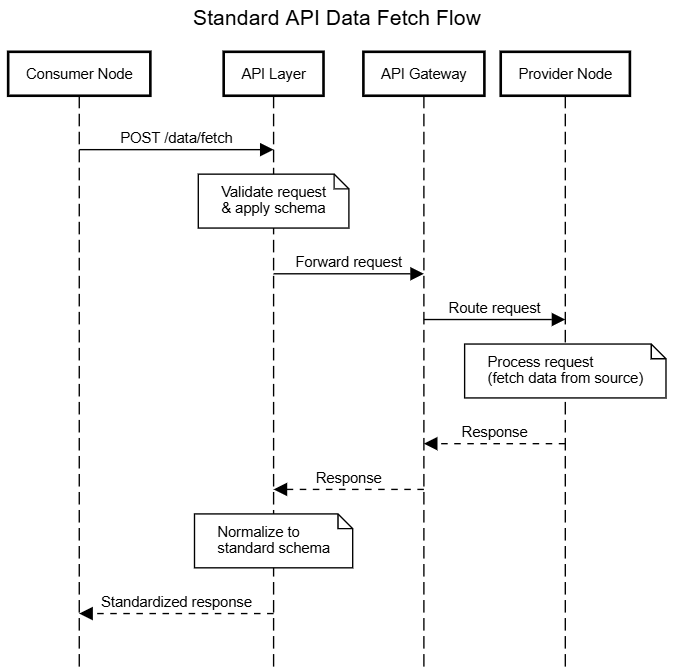
Figure 8-1: Standard API Data Fetch Flow: standardized data request through API Layer, Gateway, and Provider Node
Content-Type: application/json
{
  "transactionId": "7f3d4a21-8b9c-4e1f-a2d3-5c6e7f8a9b0c",
  "status": "SUCCESS",
  "providerId": "prov_health_registry",
  "data": {
    "immunizationStatus": "COMPLETE",
    "lastDoseDate": "2025-01-10",
    "vaccineCount": 8
  },
  "timestamp": "2026-04-18T10:00:02Z",
  "providerSignature": "MEUCIQDy7KpX...",
  "proofRef": "tpl-889922-abc",
  "schemaVersion": "1.0.0",
  "datasetId": "health.immunization"
}
8.3 getSchema Endpoint
8.3.1 Example Request and Response
Authorization: Bearer eyJhbGci...
HTTP/1.1 200 OK
Cache-Control: max-age=3600
GET /v1/schema/health.immunization?version=1.0.0 HTTP/1.1
Host: api.wasl.gov.pk
Content-Type: application/json{
"$schema": "https://json-schema.org/draft/2020-12/schema",
"$id": "https://schemas.wasl.gov.pk/v1/health.immunization/1.0.0",
"title": "Health Immunization Record",
"version": "1.0.0",
"datasetId": "health.immunization",
"domain": "health",
"classification": "restricted_personal",
"consentRequired": true,
"subjectType": "natural_person",
"type": "object",
"required": ["immunizationStatus"],
"properties": {
"immunizationStatus": { "type": "string", "enum": ["COMPLETE","PARTIAL","NONE"] },
"lastDoseDate": { "type": ["string","null"], "format": "date" },
"vaccineCount": { "type": "integer", "minimum": 0 },
"nextScheduledDate": { "type": ["string","null"], "format": "date" }
}
}8.4 getConsentInfo Endpoint
Authorization: Bearer eyJhbGci...
HTTP/1.1 200 OK
GET /v1/consent/cons-99821-abcd-ef01 HTTP/1.1
Host: api.wasl.gov.pk
{
"consentId": "cons-99821-abcd-ef01",
"subjectId": "CNIC:35201-1234567-3",
"consumerId": "edu_dept_punjab",
"providerId": "prov_health_registry",
"datasetId": "health.immunization",
"fields": ["immunizationStatus","lastDoseDate"],
"purpose": "school_admission",
"validFrom": "2026-04-18T10:00:00Z",
"validTo": "2026-04-30T23:59:59Z",
"status": "ACTIVE",
"channel": "pak_id_app",
"signature": "MEUCIQDzConsent..."
}8.5 getTransactionTPLStatus Endpoint
Authorization: Bearer eyJhbGci...
HTTP/1.1 200 OK
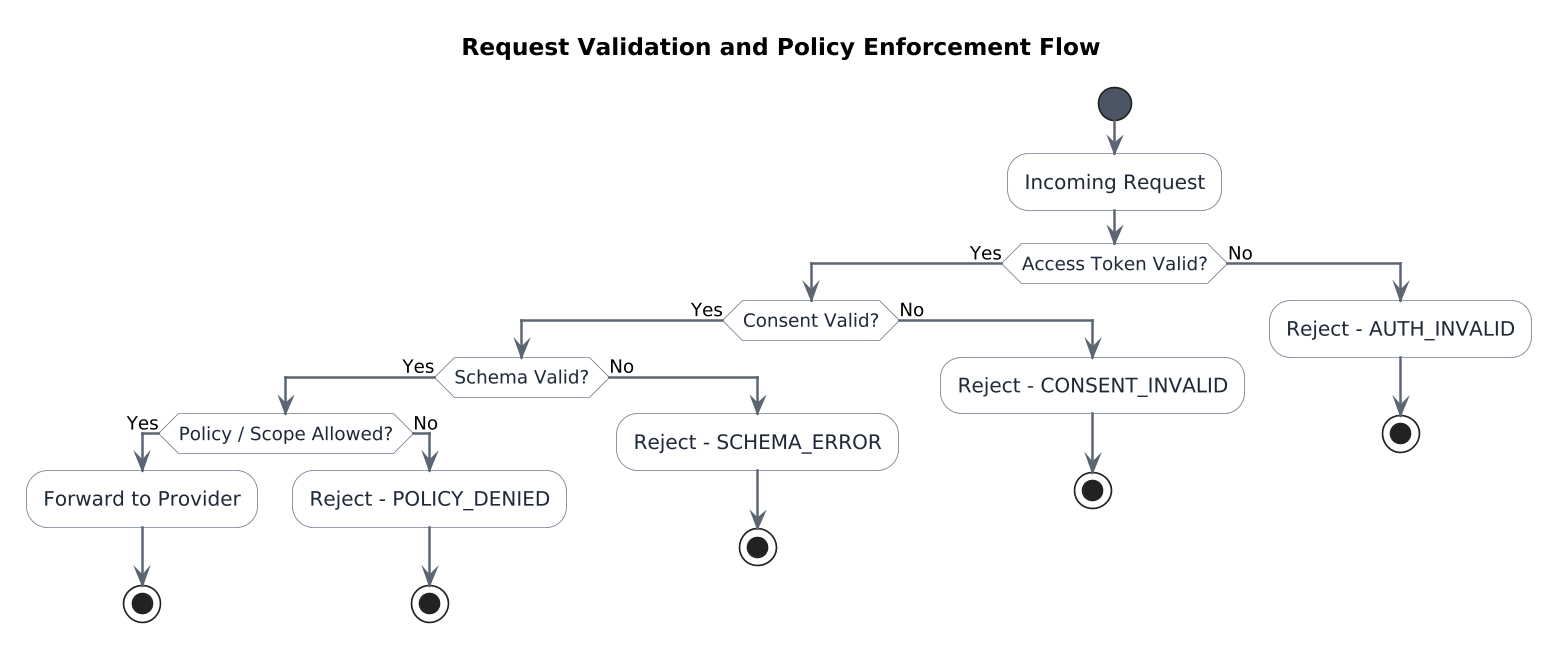
Figure 8-2: API Gateway Validation Pipeline, sequential validation steps before a request is allowed to reach the provider
GET /v1/tpl/7f3d4a21-8b9c-4e1f-a2d3-5c6e7f8a9b0c HTTP/1.1
Host: api.wasl.gov.pk
{
"transactionId": "7f3d4a21-8b9c-4e1f-a2d3-5c6e7f8a9b0c",
"status": "RECORDED",
"requestHash": "sha256:a1b2c3d4e5f6...",
"responseHash": "sha256:f6e5d4c3b2a1...",
"consentHash": "sha256:c0nsent1234...",
"consumerId": "edu_dept_punjab",
"providerId": "prov_health_registry",
"timestamp": "2026-04-18T10:00:03Z",
"providerSignature": "MEUCIQDyProv...",
"gatewaySignature": "MEUCIQDzGw...",
"merkleProof": {
"treeId": "tpl-batch-2026-04-18-001",
"leaf": "sha256:leaf_hash_abc",
"path": ["sha256:sibling1...", "sha256:sibling2..."],
"root": "sha256:merkle_root_xyz"
}
}8.6 Asynchronous Processing Pattern
For long-running or multi-step workflows, the getData API supports asynchronous processing. The consumer includes async: true in the request body. The API Gateway returns immediately with HTTP 202 Accepted and a polling URL.
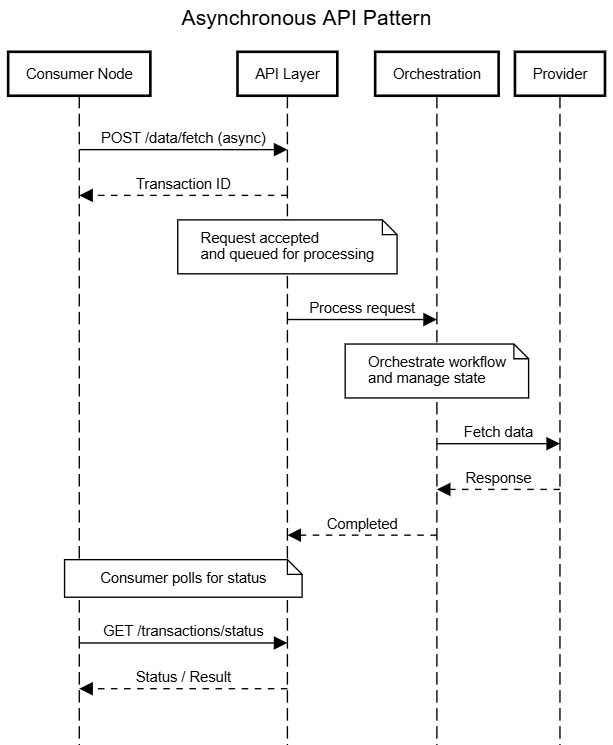
Figure 8-3: Asynchronous API Pattern, long-running data requests handled using transaction-based asynchronous processing
// Async request — additional fields in request body
{ "async": true, "callbackUrl": "https://api.bank.com/wasl/cb", ... }
// Immediate response (HTTP 202 Accepted)
{
  "transactionId": "7f3d4a21-...",
  "status": "PENDING",
  "pollUrl": "https://api.wasl.gov.pk/v1/async/7f3d4a21-.../status",
  "estimatedCompletionSeconds": 15
}
9 METADATA RECORD FORMAT
The Metadata Repository is the authoritative control-plane registry for the WASL ecosystem, maintaining machine-readable dataset definitions, provider bindings, consent policies, and classification rules. Unlike data, which remains federated with each owning organization, the Metadata Repository is deliberately centralized within the Central WASL Platform. This centralization is intentional: a single authoritative source for schemas, provider bindings, and consent policies is what enables the standardize-once, consume-everywhere model, any Client Node, in any province, connecting to any provider, resolves the same schema definitions and routing rules without bilateral coordination. This section specifies the technical formats and schemas for metadata records. Sections 9.4 and 9.5 below cover ZKP capability annotations and the Provider Directory respectively.
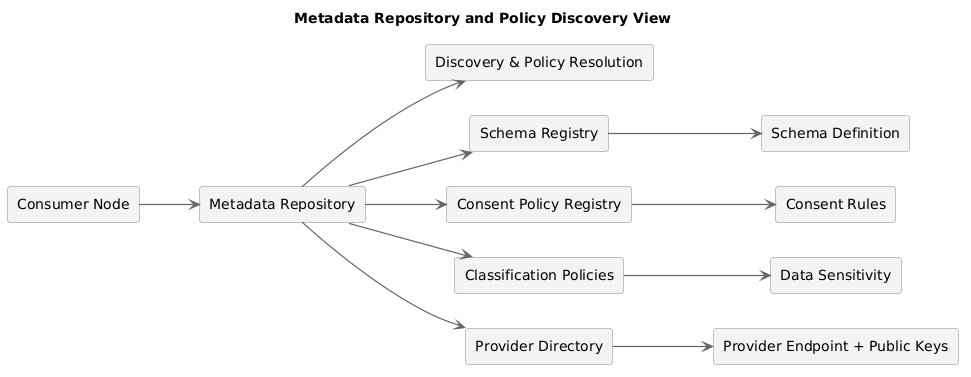
Figure 9-1: Metadata Repository in the WASL Control Plane, central control-plane registry exposing schemas, provider mappings, consent rules, and classification policies
9.1 Metadata Record JSON Schema
Every dataset or service registered in the WASL Metadata Repository SHALL conform to the following JSON schema. This is the authoritative format for all metadata records published via the getSchema and listDatasets APIs.
{
  "$schema": "https://json-schema.org/draft/2020-12/schema",
  "$id": "https://schemas.wasl.gov.pk/v1/metadata-record.json",
  "title": "WASL Metadata Record",
  "type": "object",
  "required": ["datasetId","datasetName","domain","providerId",
               "schemaVersion","subjectType","classification",
               "consentRequired","allowedPurposes","authMethod",
               "endpointRef","publicKeyRef","status"],
  "additionalProperties": false,
  "properties": {
    "datasetId": {
      "type": "string",
      "pattern": "^[a-z][a-z0-9]*\\.[a-z][a-z0-9._-]*$",
      "examples": ["health.immunization","land.record.ownership"]
    },
    "datasetName": { "type": "string", "maxLength": 200 },
    "description": { "type": "string", "maxLength": 2000 },
    "domain": {
      "type": "string",
      "enum": ["civil_registry","land","tax","health","education",
               "business","financial","social_protection","legal",
               "transport","custom"]
    },
    "providerId": { "type": "string" },
    "providerName": { "type": "string" },
    "schemaVersion": { "type": "string", "pattern": "^\\d+\\.\\d+\\.\\d+$" },
    "schemaRef": { "type": "string", "format": "uri" },
    "subjectType": {
      "type": "string",
      "enum": ["natural_person","legal_person","non_personal"]
    },
    "classification": {
      "type": "string",
      "enum": ["public","internal","confidential",
               "restricted_personal","highly_sensitive"]
    },
    "consentRequired": { "type": "boolean" },
    "consentPolicyRef": { "type": "string" },
    "allowedPurposes": {
      "type": "array", "items": { "type": "string" }, "minItems": 1
    },
    "authMethod": {
      "type": "string", "enum": ["oauth2_mtls","oauth2_jwt","oidc"]
    },
    "endpointRef": { "type": "string" },
    "publicKeyRef": { "type": "string" },
    "zkpSupported": { "type": "boolean", "default": false },
    "zkpFields": { "type": "array", "items": { "type": "string" } },
    "eventSubscriptionSupported": { "type": "boolean", "default": false },
    "status": {
      "type": "string",
      "enum": ["active","deprecated","retired","sandbox_only"]
    },
    "deprecationDate": { "type": "string", "format": "date" },
    "retirementDate": { "type": "string", "format": "date" },
    "backwardCompatibleVersions": {
      "type": "array", "items": { "type": "string" }
    },
    "publishedAt": { "type": "string", "format": "date-time" },
    "lastUpdated": { "type": "string", "format": "date-time" }
  }
}
9.2 Example Metadata Record
{
  "datasetId": "land.record.ownership",
  "datasetName": "Land Ownership Record",
  "description": "Authoritative land ownership records from provincial land authorities.",
  "domain": "land",
  "providerId": "punjab_land_authority",
  "providerName": "Punjab Land Records Authority",
  "schemaVersion": "1.2.0",
  "schemaRef": "https://schemas.wasl.gov.pk/v1/land.record.ownership/1.2.0",
  "subjectType": "natural_person",
  "classification": "restricted_personal",
  "consentRequired": true,
  "consentPolicyRef": "policy-land-personal-001",
  "allowedPurposes": ["subsidy_eligibility","credit_assessment","legal_verification"],
  "authMethod": "oauth2_mtls",
  "endpointRef": "/v1/data/fetch",
  "publicKeyRef": "pk-punjab-land-01",
  "zkpSupported": false,
  "eventSubscriptionSupported": true,
  "status": "active",
  "backwardCompatibleVersions": ["1.1.0","1.0.0"],
  "publishedAt": "2026-01-15T00:00:00Z",
  "lastUpdated": "2026-04-01T00:00:00Z"
}
9.3 Metadata Caching and Synchronisation
Client Nodes SHALL maintain a local cache of metadata records. The cache SHALL be refreshed on startup; on cache TTL expiry (Example default: 3600 seconds); on receipt of a cache invalidation notification; and on encountering an unknown datasetId. Cached metadata bundles SHALL be digitally signed by the WASL Metadata Repository. Client Nodes SHALL verify the signature before using cached metadata.
9.4 Zero-Knowledge Proof (ZKP) Support in Data Schemas
Selected WASL schemas may include annotations indicating that certain fields are eligible for privacy-preserving proof-based responses. Instead of transmitting the full underlying value, a provider may return a cryptographic proof of a specific predicate, such as confirmation that the subject is above a required age threshold, that a compliance condition is satisfied, or that an eligibility criterion has been met. The metadata record for a ZKP-capable schema shall indicate: whether proof-based response is supported; which fields or predicates are eligible; what proof format is expected; and whether verifier-side validation rules apply. This is an advanced data-minimization capability and is not the default response mode.
| Scenario | Outcome |
|---|---|
| Dataset not registered | Request cannot proceed — SCHEMA_DATASET_NOT_FOUND |
| Schema version unsupported | Reject or invoke compatibility handling |
| Provider inactive | Routing blocked — PROVIDER_UNAVAILABLE |
| Metadata signature invalid | Cache update rejected |
| Consent policy missing | Treat as non-routable until resolved |
| Classification undefined | Reject publication or block use |
9.5 Provider Directory and Service Binding
The Metadata Repository maintains a Provider Directory that binds each dataset to the organizations authorized to serve it. For each registered provider, the directory records: provider identifier and organization name; provider type; active datasets and endpoint references; public key reference or certificate chain; operational status; supported protocol types (REST, gRPC, GraphQL, event); and region or jurisdiction where relevant. This enables a Consumer Client Node to discover not only what dataset exists but which registered provider is authorized and technically available to serve it.
9.5a Province-Code Routing Key Pattern
Where a single national schema is served by multiple provincial or regional providers (for example, a national vehicle excise transfer schema served by four provincial Excise Departments), the Provider Directory SHALL support province-code routing keys so that a Consumer submits one request and the Orchestration Services resolve the correct provider at runtime. This avoids requiring a separate governance approval per province and enables a single schema publication to cover all providers. The routing key pattern works as follows: (a) the domain custodian (typically a federal ministry or PDA) publishes one national schema in the Metadata Repository with domain=custom and the metadata record includes a routingKeyField specifying which request field carries the routing discriminator (example: province_code); (b) each provincial Client Node registers as a provider against the same datasetId, declaring its supported routingKeyValues (example: ["KP","PB","SD","BL"]); (c) the Orchestration Services evaluate the routingKeyField at transaction time to dispatch to the appropriate provider; (d) if no routingKeyValue matches, the API Gateway returns PROVIDER_UNAVAILABLE. One PDA governance approval covers the national schema; each provincial provider's registration is an administrative act, not a new governance approval cycle.
The routingKeyField SHALL be declared in the metadata record as a top-level property: {"routingKeyField": "province_code", "routingKeyValues": ["KP","PB","SD","BL"]}. Provider registrations in the directory that include routingKeyValues are treated as regional providers for that dataset. A Consumer may target a specific province by populating the routing key field in the getData request envelope, or may request fan-out to all registered provincial providers (for aggregate queries) by omitting the field; in fan-out mode, Orchestration Services dispatch concurrently and aggregate results per the composite workflow pattern (Section 26.5).
9.5b: Provider Public Key Publication (JWKS)
Every registered Provider SHALL publish a JWK Set (JWKS) conforming to RFC 7517. The Metadata Repository SHALL expose each Provider's JWKS at a well-known path derived from the Provider's registered providerId:
Each JWK in the set SHALL carry the following required fields: kty (key type, EC for ECDH/ECDSA keys); use (key use — enc for encryption keys used in E2E payload encryption, sig for signing keys); crv (curve, P-256 minimum); kid (key identifier, a stable UUID or SHA-256 thumbprint of the public key); x and y (public key coordinates, base64url-encoded); and nbf and exp (not-before and not-after timestamps for key validity). A key rotation schedule SHALL be specified: Provider encryption keys SHALL be rotated at minimum annually; the outgoing key SHALL remain published in the JWKS with use: enc and an exp timestamp for a minimum 7-day overlap period to allow in-flight transactions to complete. Client Nodes SHALL re-fetch the JWKS on cache TTL expiry (default 24 hours) and on receipt of a DECRYPTION_FAILED error indicating a possible key rotation event.
GET /v1/providers/{providerId}/jwks.json10 CONSENT POLICY FORMAT AND CONSENT ARTIFACT SPECIFICATION
This section specifies the technical representation, exchange, and validation of consent and other authorization artefacts within WASL. The determination of when consent is required, the lawful bases for processing personal data, organization eligibility for non-consent authorization, and applicable exemptions are governed by the WASL Consent Governance Guidelines (DNP-D.250_GDL_v0.1) issued separately by the Pakistan Digital Authority. Implementations SHALL enforce the consent policies published in the Consent Policy Registry. The Consent Layer manages the full lifecycle of citizen consent for personal data exchange. This section specifies the technical formats for consent policy records and consent artifacts. The sub-clauses below provide the operational context for how consent is collected, enforced at runtime, and revoked. The substantive policy framework governing which data categories require consent, which authorization bases are recognized, and which organization classes qualify for exemption or modified consent treatment is defined in Annex E (NORMATIVE): WASL Consent Policy Framework, which is normative and SHALL be read in conjunction with this section.
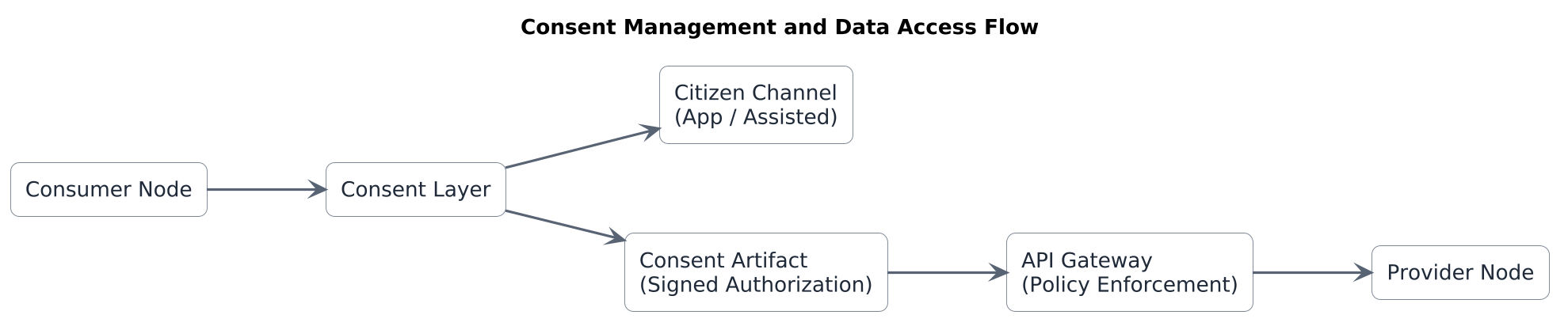
Figure 10-1: Consent Layer in WASL Architecture — consent is obtained, converted into a verifiable artifact, and enforced during data exchange
When a consumer requests data requiring citizen consent, the Consent Layer initiates an asynchronous consent collection flow. The citizen is notified through an approved channel, primarily the PAK-ID mobile application, and a later stage, possibly with USSD/IVR and in-person assisted consent available for citizens without smartphone access, and presented with a plain-language description of what data is requested, by which organization, for what stated purpose, and for how long consent will be valid. Notifications shall be in Urdu and applicable regional languages. On citizen approval, a signed consent artifact is generated and the pending getData request proceeds. On rejection or timeout, the request is terminated with CONSENT_REQUIRED.
Citizens may revoke previously granted consent at any time through any supported consent channel. Upon revocation, the Consent Layer immediately updates the consent artifact status to REVOKED, propagates the revocation to the Consent Policy Registry, and ensures subsequent getData requests referencing the revoked consentId are rejected within 5 seconds. The revocation timestamp and reason are recorded in the consent log. Event subscriptions bound to the revoked consent are automatically terminated.
10.1 Consent Policy Record — JSON Schema
Consent policies define the rules governing whether, how, and under what conditions citizen consent is required for a given dataset, field, or purpose combination. Policies are published in the Consent Policy Registry and enforced at runtime by the Consent Layer, API Gateway, and Provider Fulfilment Layer.
{
  "$schema": "https://json-schema.org/draft/2020-12/schema",
  "$id": "https://schemas.wasl.gov.pk/v1/consent-policy.json",
  "title": "WASL Consent Policy Record",
  "type": "object",
  "required": ["policyId","datasetId","consentRequired",
               "authorizationBasis","fieldLevelPolicies",
               "validityModel","revocable","channels"],
  "properties": {
    "policyId": { "type": "string" },
    "datasetId": { "type": "string" },
    "version": { "type": "string" },
    "consentRequired": { "type": "boolean" },
    "authorizationBasis": {
      "type": "string",
      "enum": ["explicit_consent","implicit_consent",
               "statutory_authority","public_data","law_enforcement"]
    },
    "exemptOrgTypes": {
      "type": "array", "items": { "type": "string" }
    },
    "fieldLevelPolicies": {
      "type": "array",
      "items": {
        "type": "object",
        "required": ["fieldName","consentRequired"],
        "properties": {
          "fieldName": { "type": "string" },
          "consentRequired": { "type": "boolean" },
          "sensitivityLevel": {
            "type": "string", "enum": ["low","medium","high","critical"]
          },
          "maskingAllowed": { "type": "boolean" }
        }
      }
    },
    "validityModel": {
      "type": "object",
      "properties": {
        "maxValidityDays": { "type": "integer", "minimum": 1, "maximum": 365 },
        "purposeBound": { "type": "boolean" },
        "renewalAllowed": { "type": "boolean" }
      }
    },
    "revocable": { "type": "boolean" },
    "channels": {
      "type": "array",
      "items": { "type": "string",
        "enum": ["pak_id_app","sms_ussd","assisted","call_center","offline_deferred"]
      }
    },
    "purposeRestrictions": { "type": "array", "items": { "type": "string" } },
    "legislativeRef": { "type": "string" }
  }
}
10.2 Consent Artifact: JSON Schema
Every approved consent request SHALL produce a signed consent artifact. This is the authoritative evidence of citizen authorization and SHALL be attached to all getData requests for consent-governed datasets.
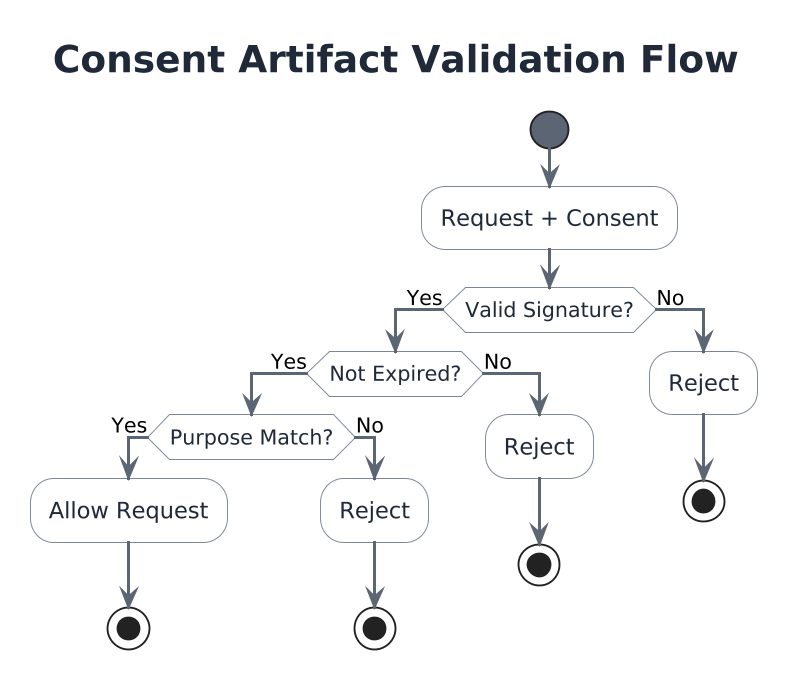
Figure 10-2: Consent Validation at Runtime, consent artifacts are validated during request processing at the API Gateway and Provider Node
{
  "$schema": "https://json-schema.org/draft/2020-12/schema",
  "$id": "https://schemas.wasl.gov.pk/v1/consent-artifact.json",
  "title": "WASL Consent Artifact",
  "type": "object",
  "required": ["consentId","subjectId","consumerId","providerId",
               "datasetId","purpose","validFrom","validTo","status",
               "channel","signature"],
  "properties": {
    "consentId": { "type": "string", "format": "uuid" },
    "subjectId": { "type": "string",
      "description": "Format: <idType>:<idValue> e.g. CNIC:35201-1234567-3" },
    "consumerId": { "type": "string" },
    "providerId": { "type": "string" },
    "datasetId": { "type": "string" },
    "fields": { "type": "array", "items": { "type": "string" },
      "description": "Field-level scope of consent. Empty = all consented fields." },
    "purpose": { "type": "string" },
    "validFrom": { "type": "string", "format": "date-time" },
    "validTo": { "type": "string", "format": "date-time" },
    "status": {
      "type": "string",
      "enum": ["ACTIVE","EXPIRED","REVOKED","PENDING","REJECTED"]
    },
    "channel": { "type": "string" },
    "subjectSignature": { "type": "string",
      "description": "Digital signature from citizen via PAK-ID (where applicable)." },
    "signature": { "type": "string",
      "description": "WASL platform digital signature over the consent artifact." },
    "revocationTimestamp": { "type": "string", "format": "date-time" },
    "revocationReason": { "type": "string" },
    "createdAt": { "type": "string", "format": "date-time" }
  }
}
10.3 Consent Validation Requirements at Runtime
Before a getData request proceeds, the following consent validations SHALL be performed in sequence:
| Step | Check | Failure Code |
|---|---|---|
| 1 | Consent artifact present (if dataset is consent-governed) | CONSENT_REQUIRED |
| 2 | Consent artifact platform signature is valid | CONSENT_INVALID |
| 3 | consentId in artifact matches consentId in request envelope | CONSENT_MISMATCH |
| 4 | consumerId in artifact matches requesting entity org_id | CONSUMER_MISMATCH |
| 5 | providerId in artifact matches target provider | PROVIDER_MISMATCH |
| 6 | datasetId in artifact matches requested datasetId | DATASET_MISMATCH |
| 7 | purpose in artifact matches purpose in request envelope | PURPOSE_MISMATCH |
| 8 | Current timestamp is within [validFrom, validTo] window | CONSENT_EXPIRED |
| 9 | status field is ACTIVE (not REVOKED or EXPIRED) | CONSENT_REVOKED |
| 10 | Requested fields are within the consented field scope | FIELD_OUT_OF_SCOPE |
11 DATA CLASSIFICATION TECHNICAL CONTROLS MAPPING
11.1 Classification Tiers
| Tier | Label | Definition |
|---|---|---|
| 1 | Public | Data that may be shared without restriction. No consent required. Minimal access controls. |
| 2 | Internal | Data restricted to authorized institutions under defined use cases. No citizen consent required but organization-level access control applies. |
| 3 | Confidential | Sensitive institutional data requiring elevated access controls. Consent depends on policy; statutory authority may apply. |
| 4 | Restricted Personal | Personal data relating to natural persons. Citizen consent or statutory legal basis required. End-to-end encryption is mandatory. |
| 5 | Highly Sensitive | Data presenting heightened risk if disclosed. Enhanced controls, minimal retention, and elevated approval requirements. |
11.2 Technical Controls Mapping
| Control Domain | Public | Internal | Confidential | Restricted Personal | Highly Sensitive |
|---|---|---|---|---|---|
| Transport Encryption (TLS 1.3) | REQ | REQ | REQ | REQ | REQ |
| End-to-End Payload Encryption | — | REC | REQ | REQ | REQ |
| mTLS Authentication | REQ | REQ | REQ | REQ | REQ |
| Citizen Consent | — | — | DEPENDS | REQ | REQ (enhanced) |
| Purpose Binding | REC | REQ | REQ | REQ | REQ |
| Field-level Minimization | OPT | REC | REQ | REQ | REQ |
| Audit Logging | Standard | Standard | Restricted | Masked | Minimal & Masked |
| TPL Recording | REQ | REQ | REQ | REQ | REQ |
| Event Subscription Allowed | YES | Controlled | Controlled | Consent-bound | Exceptional only |
| Max Token Lifetime | 900s | 900s | 600s | 300s | 120s |
| Approval Workflow | Self-service | Auto-approval | Manual review | Contractual | Exceptional approval |
11.3 Field-level Classification Example: Civil Registry
| Field | Classification | Consent Required | Maskable |
|---|---|---|---|
| full_name | Restricted Personal | Yes | Yes (partial) |
| date_of_birth | Restricted Personal | Yes | Yes (year only) |
| gender | Internal | No | No |
| nationality | Internal | No | No |
| cnic_number | Highly Sensitive | Yes | No |
| address | Confidential | Yes | Yes |
| marital_status | Restricted Personal | Yes | No |
| biometric_reference | Highly Sensitive | Exceptional only | No |
12 ERROR CODES AND ERROR HANDLING
12.1 Error Response Format
{
  "$schema": "https://json-schema.org/draft/2020-12/schema",
  "$id": "https://schemas.wasl.gov.pk/v1/error-response.json",
  "title": "WASL Error Response",
  "type": "object",
  "required": ["transactionId","errorCode","message","timestamp"],
  "properties": {
    "transactionId": { "type": "string" },
    "errorCode": { "type": "string" },
    "httpStatus": { "type": "integer" },
    "message": { "type": "string" },
    "detail": { "type": "string" },
    "retryAfter": { "type": "integer",
      "description": "Seconds until retry permitted (rate limit errors)." },
    "timestamp": { "type": "string", "format": "date-time" }
  }
}
12.2 Authentication and Authorization Errors (4xx)
| Error Code | HTTP | Description | Recovery Action |
|---|---|---|---|
| AUTH_TOKEN_MISSING | 401 | No access token in Authorization header. | Include valid Bearer token. |
| AUTH_TOKEN_INVALID | 401 | Token signature verification failed. | Obtain new token from IAM. |
| AUTH_TOKEN_EXPIRED | 401 | Token exp claim is in the past. | Obtain new token from IAM. |
| AUTH_TOKEN_REPLAY | 401 | Token jti has been seen before. | Obtain new token with fresh jti. |
| AUTH_MTLS_FAILED | 401 | mTLS certificate validation failed. | Verify certificate chain and OCSP status. |
| AUTH_CERT_REVOKED | 401 | Client certificate has been revoked. | Contact PDA/NADRA to reissue certificate. |
| AUTH_CERT_EXPIRED | 401 | Client certificate has expired. | Renew certificate via WASL PKI portal. |
| AUTHZ_SCOPE_INSUFFICIENT | 403 | Token scope does not permit requested operation. | Request token with required scope. |
| AUTHZ_PURPOSE_MISMATCH | 403 | Declared purpose not permitted for dataset. | Use a permitted purpose code. |
| AUTHZ_DATASET_NOT_SUBSCRIBED | 403 | Entity not subscribed to requested dataset. | Subscribe via Developer Portal. |
| AUTHZ_IP_BLOCKED | 403 | Request from unregistered IP address. | Register IP in entity profile. |
12.3 Consent Errors (4xx)
| Error Code | HTTP | Description | Recovery Action |
|---|---|---|---|
| CONSENT_REQUIRED | 403 | Dataset is consent-governed; no consent artifact provided. | Initiate consent flow and attach artifact. |
| CONSENT_INVALID | 403 | Consent artifact signature verification failed. | Obtain fresh consent artifact. |
| CONSENT_EXPIRED | 403 | Consent validTo timestamp is in the past. | Request citizen to renew consent. |
| CONSENT_REVOKED | 403 | Citizen has revoked this consent. | Request citizen to grant fresh consent. |
| CONSENT_PURPOSE_MISMATCH | 403 | Request purpose does not match consented purpose. | Use the consented purpose code. |
| CONSENT_FIELD_OUT_OF_SCOPE | 403 | Requested fields not within consent scope. | Request only consented fields. |
| CONSENT_CONSUMER_MISMATCH | 403 | Consent consumerId does not match requesting entity. | Use correct consent artifact. |
| CONSENT_PENDING | 202 | Consent request initiated; awaiting citizen decision. | Poll or subscribe for consent decision. |
| CONSENT_REJECTED | 403 | Citizen rejected the consent request. | Inform end-user; cannot proceed. |
12.4 Schema and Payload Errors (4xx)
| Error Code | HTTP | Description | Recovery Action |
|---|---|---|---|
| SCHEMA_DATASET_NOT_FOUND | 404 | datasetId not registered in Metadata Repository. | Verify dataset ID. |
| SCHEMA_VERSION_NOT_FOUND | 404 | Requested schema version does not exist. | Use current version from getSchema. |
| SCHEMA_VERSION_DEPRECATED | 410 | Requested schema version is deprecated. | Migrate to current version. |
| SCHEMA_VALIDATION_FAILED | 422 | Request payload does not conform to schema. | Validate request against schema. |
| REQUEST_MALFORMED | 400 | Request envelope is malformed JSON. | Fix JSON syntax. |
| REQUEST_SIGNATURE_INVALID | 400 | Consumer digital signature over request is invalid. | Re-sign request with entity private key. |
| REQUEST_TIMESTAMP_STALE | 400 | Request timestamp outside 5-minute skew window. | Sync clock and retry. |
| TRANSACTION_ID_DUPLICATE | 409 | transactionId has been used before. | Generate new UUID v4 transactionId. |
| SUBJECT_NOT_FOUND | 404 | No record found for the given subject identifier. | Verify subject identifier. |
12.5 Provider and Platform Errors (5xx)
| Error Code | HTTP | Description | Recovery Action |
|---|---|---|---|
| PROVIDER_UNAVAILABLE | 503 | Provider Client Node is unreachable. | Retry after retryAfter seconds. |
| PROVIDER_TIMEOUT | 504 | Provider did not respond within 30-second timeout. | Retry or use async pattern. |
| PROVIDER_SCHEMA_VIOLATION | 502 | Provider returned data not conforming to schema. | Report via PDA/NADRA support portal. |
| PROVIDER_SIGNATURE_INVALID | 502 | Provider response signature verification failed. | Do not use response; report to PDA/NADRA. |
| PROVIDER_INTERNAL_ERROR | 502 | Provider returned an internal error. | Retry; escalate if persistent. |
| PLATFORM_RATE_LIMITED | 429 | Platform rate limit exceeded. | Back off per retryAfter header. |
| TPL_RECORD_FAILED | 500 | Transaction proof could not be recorded. | Do not use response; report to PDA/NADRA. |
| IAM_UNAVAILABLE | 503 | IAM service temporarily unavailable. | Retry token request. |
12.6 Error Handling Requirements
| Error Category | Retry? | Max Retries | Backoff Strategy |
|---|---|---|---|
| AUTH_TOKEN_EXPIRED | Yes | 1 | Obtain new token, no delay |
| PROVIDER_UNAVAILABLE | Yes | 3 | Exponential: 2s, 4s, 8s |
| PROVIDER_TIMEOUT | Yes | 2 | Linear: 5s, 10s |
| PLATFORM_RATE_LIMITED | Yes | — | Honor retryAfter header |
| CONSENT_REQUIRED | No (user action needed) | — | Initiate consent flow |
| CONSENT_REVOKED | No (user action needed) | — | Inform user |
| REQUEST_SIGNATURE_INVALID | No (fix request) | — | Correct signature |
| PROVIDER_SIGNATURE_INVALID | No (security event) | — | Alert security team |
| TPL_RECORD_FAILED | No (security event) | — | Alert; do not use response |
13 TRANSACTION PROOF LAYER: TECHNICAL SPECIFICATION
The Transaction Proof Layer (TPL) provides a verifiable, tamper-evident record of every data exchange transaction, recording only cryptographic proofs, not data content. This section specifies the technical formats for TPL proof records.

Figure 13-1: Transaction Proof Generation, request, response, and consent artifacts are hashed and combined into a signed transaction proof record
For each transaction, the TPL records: transaction identifier; consumer and provider identifiers; SHA-256 hash of the request payload (consumer-signed); SHA-256 hash of the response payload (provider-signed); reference to the consent artifact; WASL platform co-signature; transaction status; RFC 3161 trusted timestamp; and Merkle proof reference once the batch is anchored. No plaintext data, field values, or citizen identifiers are stored in the TPL.
The TPL is privacy-preserving by construction: dataset identifiers rather than full payloads are recorded; status and metadata rather than raw personal data are stored; and subject identifiers are hashed or masked per the data minimisation policy. TPL records provide mathematically unforgeable evidence that a specific transaction occurred, and what was committed to by each party, making them suitable for legal proceedings, regulatory audits, and dispute resolution.
13.1 TPL Proof Record JSON Schema
{
  "$schema": "https://json-schema.org/draft/2020-12/schema",
  "$id": "https://schemas.wasl.gov.pk/v1/tpl-proof-record.json",
  "title": "WASL TPL Proof Record",
  "type": "object",
  "required": ["transactionId","requestHash","responseHash","consentHash",
               "consumerId","providerId","timestamp","cryptoSuite","tplStatus",
               "providerSignature","gatewaySignature","status"],
  "properties": {
    "transactionId": { "type": "string", "format": "uuid" },
    "requestHash": { "type": "string",
      "description": "SHA-256 of canonical request body." },
    "responseHash": { "type": "string",
      "description": "SHA-256 of response body." },
    "consentHash": { "type": "string",
      "description": "SHA-256 of consent artifact." },
    "consumerId": { "type": "string" },
    "providerId": { "type": "string" },
    "datasetId": { "type": "string" },
    "purpose": { "type": "string" },
    "timestamp": { "type": "string", "format": "date-time" },
    "tsaTimestamp": { "type": "string",
      "description": "Trusted timestamp from TSA (RFC 3161)." },
    "providerSignature": { "type": "string" },
    "gatewaySignature": { "type": "string" },
    "status": {
      "type": "string",
      "enum": ["INITIATED","VALIDATED","PROCESSING","COMPLETED","FAILED","RECORDED"]
    },
    "merkleProof": {
      "type": "object",
      "properties": {
        "treeId": { "type": "string" },
        "leaf": { "type": "string" },
        "path": { "type": "array", "items": { "type": "string" } },
        "root": { "type": "string" }
      }
    },
    "anchorRef": { "type": "string",
      "description": "External anchor reference CT-log tree ID and leaf hash." },
    "cryptoSuite": { "type": "string",
      "description": "Cryptographic algorithm suite identifier from the Cryptographic Parameter Registry. Required for forensic traceability across algorithm migrations. Example: wasl-suite-v1-ecdsa-p256-aesgcm256." },
    "tplStatus": { "type": "string",
      "enum": ["PENDING","ENDORSEMENT","COMMITTED","EXPIRED","ENDORSEMENT_FAILED"],
      "description": "TPL proof lifecycle state: PENDING \u2014 consumer proof recorded, provider pending; ENDORSEMENT \u2014 both sides received, batch circulated; COMMITTED \u2014 quorum achieved, immutably appended; EXPIRED \u2014 timeout; ENDORSEMENT_FAILED \u2014 quorum not achieved." },
    "endorserSignatures": { "type": "array",
      "description": "Endorser co-signatures over the Merkle batch root. Populated when tplStatus=COMMITTED. Each entry: endorserId, signature, timestamp.",
      "items": { "type": "object", "properties": { "endorserId": {"type":"string"}, "signature": {"type":"string"}, "timestamp": {"type":"string","format":"date-time"} } } }
  }
}
13.2 Transaction Lifecycle States
| State | Description | Triggered by |
|---|---|---|
| INITIATED | Consumer has submitted getData request; Transaction ID assigned. | Consumer Client Node |
| VALIDATED | API Gateway has verified authentication, consent, and schema. | API Gateway |
| PROCESSING | Request forwarded to Provider Client Node. | Secure Connectivity Layer |
| COMPLETED | Provider has returned signed response. | Provider Client Node |
| FAILED | Error occurred at any stage. | Any component |
| RECORDED | Cryptographic proof written to TPL. | Transaction Proof Layer |
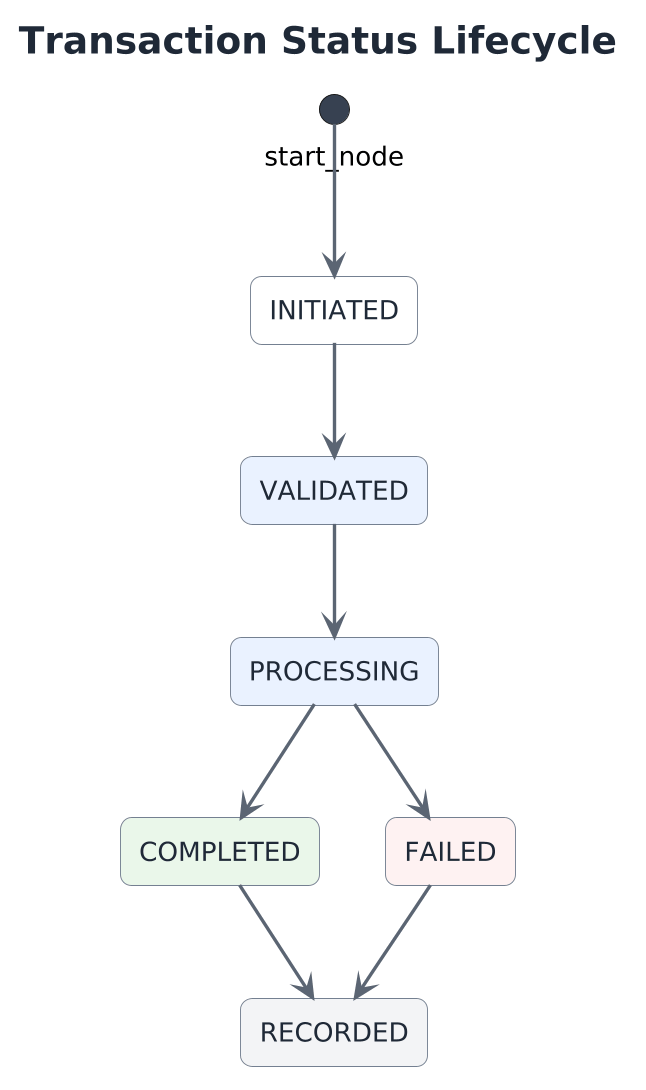
Figure 13-2: Transaction Lifecycle: a WASL transaction progresses from INITIATED through RECORDED in the Transaction Proof Layer
13.3 Signature Computation
13.3.1 Consumer Request Signature
The consumer Client Node SHALL: (1) canonicalize the request body as compact JSON with keys sorted alphabetically; (2) compute SHA-256 of the canonical JSON bytes; (3) sign the SHA-256 digest using ECDSA-P256, Ed25519, or RSA-PSS-4096 with the entity’s private key (protected per the entity’s assigned Client Category, see Section 14.2a); (4) encode the signature as base64url; and (5) include in X-WASL-Signature header and the signature field of the request envelope.
13.3.2 Provider Response Signature
The provider Fulfilment Layer SHALL: (1) concatenate requestHash || responseBodyHash (SHA-256 of response data) || timestamp (ISO 8601 UTC); (2) sign the concatenated bytes using the provider’s private key (protected per the provider’s assigned Client Category, see Section 14.2a); and (3) include as providerSignature in the response envelope and in the TPL proof record.
13.4 External Anchoring (CT-Log)
The TPL SHALL periodically anchor Merkle roots of proof records to an externally verifiable, publicly auditable log. This provides an independent, tamper-evident external anchor for all TPL proof records. Proof records are batched into Merkle trees at configurable intervals (default: every 1,000 records or 1 hour, whichever occurs first). The Merkle root hash is submitted to the designated CT-log service. The anchor reference (tree ID and leaf hash) is stored in the anchorRef field of each proof record in the batch. The external anchoring mechanism is technology-neutral at this specification level, consistent with RA Section 11.4.3. The CT-log approach is the authoritative baseline. Alternative anchoring constructions, including Trillian-style federated append-only logs with multi-party witness signatories or purpose-built multi-signature Merkle-tree constructions, may be evaluated and confirmed in downstream operational documentation provided they satisfy the append-only, cryptographic-consistency, and independently-auditable requirements. No specific distributed ledger or blockchain technology is mandated at this level.
13.5 Federated Endorsement Model
The TPL is operated as a federated, multi-party, append-only ledger. PDA is one endorser among several. A TPL batch is considered Committed only when a policy-defined quorum of endorsers has countersigned it. This section specifies the technical integration requirements for Client Nodes and the platform; the governance parameters (endorser roster, quorum threshold, legal accountability) are defined in the companion TPL Federation Regulation to be issued as a REG under the DNP-D series prior to WASL production launch.
13.5.1 Endorsement Flow
The TPL endorsement flow proceeds through the following stages for each batch: (1) Batch assembly: the TPL aggregates proof records into a Merkle tree on the configured interval trigger; (2) Root signing request: the TPL broadcasts the Merkle root hash and batch metadata to all registered endorser nodes; (3) Endorser signing: each endorser node independently verifies the batch integrity and countersigns the root hash using its HSM-protected endorser key (FIPS 140-2/3 Level 3 mandatory for endorsers per RA Section 14.2); (4) Quorum collection: the TPL collects endorser signatures until the policy-defined quorum threshold is achieved; (5) Commitment: the batch is marked COMMITTED and the endorserSignatures array in each proof record is populated; (6) CT-log anchoring: the committed batch Merkle root is submitted to the external CT-log per Section 13.4.
13.5.2 Lifecycle State Transitions
The tplStatus field (defined in Section 13.1) tracks the proof lifecycle independently of the transaction operational status. State transitions: PENDING (consumer-side proof recorded; provider-side not yet received) to ENDORSEMENT (both sides received; Merkle batch assembled and circulated to endorsers) to COMMITTED (quorum achieved; batch immutably appended and CT-log anchored). Failure paths: PENDING records unresolved beyond a configurable timeout (default: 10 minutes) transition to EXPIRED and are themselves recorded as evidence of a non-completion event. If a quorum cannot be achieved within the configured endorsement window (default: 30 minutes), the batch transitions to ENDORSEMENT_FAILED; this event is flagged for operational investigation and does not silently disappear. Neither EXPIRED nor ENDORSEMENT_FAILED records are deleted; both remain in the TPL as permanent evidence.
13.5.3 Endorser Node Technical Requirements
Each TPL endorser node SHALL: maintain a persistent connection to the WASL TPL service over mTLS (per Section 5.2); hold its endorser signing key in a FIPS 140-2/3 Level 3 HSM (mandatory; no software keystore exception); respond to signing requests within the operational latency commitment specified in the TPL Federation Regulation; maintain its own local copy of all committed batch records for independent auditability; implement key rotation procedures per the TPL Federation Regulation; and expose a public verification endpoint at which any party may retrieve endorser public keys to independently verify committed batch signatures. Endorser availability SLA is defined in the TPL Federation Regulation; the technical minimum is 99.5% measured monthly. An endorser that fails to respond within the signing window for three consecutive batches is marked inactive and the remaining endorsers continue toward quorum if the threshold remains achievable.
14 SECURITY ARCHITECTURE: TECHNICAL SPECIFICATION
This section specifies the cryptographic algorithm requirements, PKI architecture, end-to-end encryption protocol, and threat mitigation controls for WASL. The security architecture implements a Zero Trust model combined with a three-party cryptographic trust framework: the consumer independently verifies the provider’s response signature using the locally cached provider public key; the provider independently verifies the consumer’s request signature; and both parties verify WASL-issued consent artifacts using the platform’s public key. Neither party needs to extend blind trust to the central platform for data integrity.
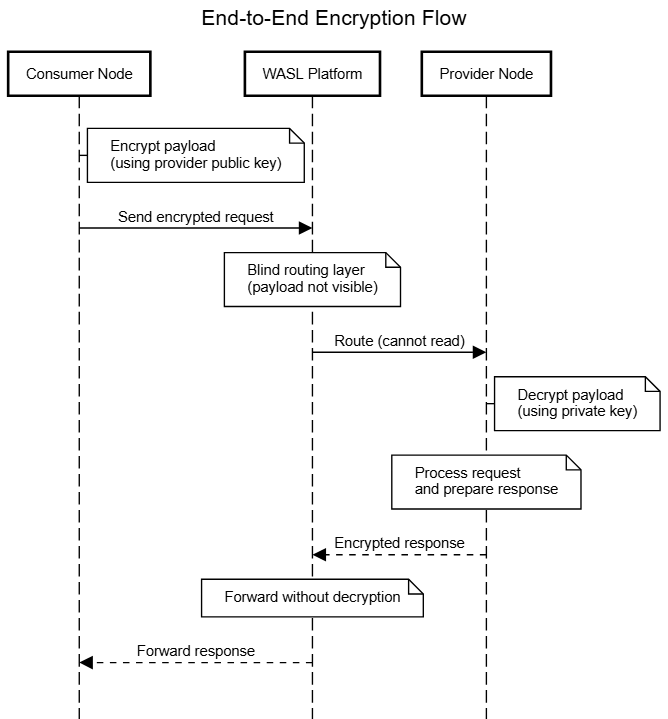
Figure 14-1: End-to-End Encryption and Data Blindness, WASL routes encrypted payloads without accessing underlying data
14.1 Cryptographic Algorithm Requirements
| Function | Required Algorithm | Key Size | Standard | Min PSS CP Grade |
|---|---|---|---|---|
| Digital Signatures (Entity) | ECDSA with P-256 | 256-bit | FIPS 186-5 | Level B (CAT-C/D only, see Section14.2a(iv)) |
| Digital Signatures (CA) | ECDSA with P-384 or RSA-PSS | 384-bit / 4096-bit | FIPS 186-5 | Level B / Level C |
| JWT Signing (IAM) | ES256 (ECDSA P-256) or RS256 | 256-bit / 2048-bit min | RFC 7518 | Level B (ES256) /Level A (RS256) |
| Symmetric Encryption | AES-256-GCM | 256-bit | FIPS 197 | Level C (satisfies all categories) |
| Session Key Encapsulation | ECDH-ES (P-256) + AES-256-GCM | 256-bit | RFC 7518 | Level B (ES256) /Level C (AES-256-GCM) |
| Hash Function | SHA-256 minimum; SHA-384 preferred | 256/384-bit | FIPS 180-4 | Level A (SHA-256)/Level B (SHA-384) |
| TLS Cipher Suite | TLS_AES_256_GCM_SHA384 | 256-bit | RFC 8446 | Level C (AES-256) /Level B (SHA-384) |
| Key Protection (Entity) | Key Protection: per Client Category (Section 14.2a): CAT-A (TPL Endorsers): FIPS 140-2/3 Level 3 HSM mandatory. CAT-B (high-risk Tier 4/5 providers): HSM strongly recommended. CAT-C/D: software keystore acceptable with minimum controls per Section 14.2a. IAM platform signing keys: FIPS 140-2/3 Level 3 HSM mandatory regardless of entity category. | N/A | FIPS 140-2/3 | N/A, Key Protection is a CE Security Level control, not a CP Grade control. |
14.2 PKI Architecture
| Component | Role | Key Storage |
|---|---|---|
| Root CA | Trust anchor for Government Sector will be DCS while for all other entities, it will be ECAC. Offline, air-gapped. Issues Intermediate CA certs only. | FIPS 140-2/3 Level 4 HSM |
| Intermediate CA (Entity Signing) | Issues entity signing certificates. | FIPS 140-2/3 Level 3 HSM |
| Intermediate CA (VPN Device) | Issues VPN device certificates for IPSec. | FIPS 140-2/3 Level 3 HSM |
| Registration Authority, Government (RA-GOV | Validates identity of government Participating Entities before certificate issuance under the DCS root CA. Operated by the Department of Communication Security (DCS). | Software-based with MFA |
| Registration Authority, Non-Government (RA-PRIV) | Validates identity of regulated private-sector and other non-government Participating Entities before certificate issuance under the ECAC root CA. Operated under arrangement between PDA and the Electronic Certification Accreditation Council (ECAC). | Software-based with MFA |
| Validation Authority (VA) | Provides OCSP responses and CRL. | HSM-protected signing key |
| Timestamping Authority (TSA) | Issues RFC 3161 timestamps for TPL proof records. | FIPS 140-2/3 Level 3 HSM |
14.2a Key Management: Client Category Framework
Per RA Section 14.2, private key protection requirements are risk-differentiated by entity type and the data tiers served. WASL defines four Client Categories. An entity’s Client Category is determined at onboarding (see Section 18), recorded in the Provider Directory, and must be declared in the PKI Certificate Signing Request. Category upgrades trigger automatically when dataset subscriptions change; downgrades require approval.
CAT-A TPL Federated Endorsers
Applies to: designated TPL endorser institutions. Key protection: FIPS 140-2/3 Level 3 Hardware Security Module, mandatory. No software keystore exception is permitted for TPL endorser signing keys. This requirement applies only to the endorser role; the same institution’s participation as a Data Provider or Consumer is governed by its applicable data-role category below.
CAT-B High-Risk Data Providers and Consumers
Applies to: entities serving or consuming Tier 4 (Restricted Personal) or Tier 5 (Highly Sensitive) data as a primary Provider; includes NADRA (civil registry), FBR (tax), provincial health departments, provincial land record authorities, and SECP-regulated financial data custodians. Key protection: FIPS 140-2/3 Level 3 HSM, strongly recommended. A CAT-B entity that cannot deploy an HSM SHALL submit a written derogation request documenting compensating controls; Approval is required before production activation. Approved compensating controls must satisfy all requirements in Section 14.2a(ii) plus additional controls agreed with PDA.
CAT-C Standard Data Providers and Consumers
Applies to: regulated financial institutions, federal ministries, and provincial agencies serving Tier 2 (Internal) or Tier 3 (Confidential) data, or consuming Tier 4 data without holding the authoritative source. Key protection: software keystore acceptable, subject to minimum controls in Section 14.2a(ii). HSM adoption is strongly recommended where Tier 4 data is routinely served; HSM for CAT-C entities upon evidence of elevated operational risk maybe required.
CAT-D Low-Risk and Public Data Consumers
Applies to: research institutions, public-interest analytics consumers, and government agencies consuming only Tier 1 (Public) or Tier 2 (Internal) data; developer sandbox participants. Key protection: software keystore acceptable. HSM is not required but is never prohibited.
Minimum Controls for Software Keystores (CAT-C and CAT-D)
Where a software keystore is used, the following minimum controls SHALL apply: (a) Encryption at rest, private key material SHALL be encrypted using AES-256-GCM; the encryption key SHALL be stored separately from the private key, preferably in a dedicated secrets management service or platform KMS; (b) Access control, key access SHALL be restricted to the WASL Client Node process identity; no human operator SHALL have direct programmatic access to the private key in production; (c) Audit logging, all key access events (use, rotation, deletion) SHALL be recorded and correlated with WASL transaction identifiers; (d) Key rotation, keys SHALL be rotated at least annually or immediately upon suspected compromise; rotation events SHALL be reported through the entity-notification channel; (e) Infrastructure isolation, the Client Node runtime SHALL be isolated from general-purpose workloads (container-level isolation with seccomp/AppArmor profiles as minimum); (f) Secrets management platform, use of a FIPS-validated software KMS or dedicated secrets manager is strongly recommended for CAT-C entities.
IAM Platform Key Management
The IAM platform’s own signing keys (used to sign access tokens and consent artefacts) are subject to a separate mandatory HSM requirement per Section 6.3 (FIPS 140-2/3 Level 3 minimum). This requirement applies to the platform operator regardless of the Client Category system, which governs only Participating Entity key management.
14.2a(iv): PSS Security Level and CP Grade Requirements by Client Category
In accordance with Pakistan Security Standards, each WASL Client Category is assigned a minimum PSS Cryptographic Equipment (CE) Security Level and Cryptographic Primitive (CP) Security Grade as follows. These are floor requirements; entities may implement at a higher level.
Where a single entity holds multiple roles (e.g., a CAT-A TPL Endorser that is also a CAT-B Data Provider), the highest applicable category's cryptographic requirements apply to all its WASL signing keys.
| Client Category | Entity Examples | Min PSS CE Level | Min PSS CP Grade | Rationale |
|---|---|---|---|---|
| CAT-A — TPL Endorsers | Designated statutory endorser institutions | CE Level 4 | CP Grade C | Highest assurance required; underpins non-repudiation of national transaction record |
| CAT-B — High-Risk Providers/Consumers | NADRA, FBR, provincial health depts, land record authorities, SECP-regulated financial custodians | CE Level 3 | CP Grade A | Tier 4/5 personal data; elevated physical security, identity-based auth, and stronger primitives required |
| CAT-C — Standard Providers/Consumers | Federal ministries, regulated financial institutions, provincial agencies (Tier 2–3 data) | CE Level 2 | CP Grade B | Standard regulated context; tamper-evident physical controls and Grade A primitives sufficient |
| CAT-D — Low-Risk/Public Consumers | Research institutions, analytics consumers, Tier 1–2 only, developer sandbox | CE Level 1 | CP Grade A | Minimum baseline; basic security requirements apply |
14.3 End-to-End Encryption Protocol
For Tier 4 and Tier 5 data, the following end-to-end encryption protocol SHALL be used between Consumer and Provider Client Nodes:
The Consumer SHALL include transactionId and datasetId as additional members in the JWE protected header so that the Provider can verify the HKDF derivation context before and independently of decryption. These values bind the session key to the specific transaction and prevent cross-transaction key reuse. The session key derived in Step 4 is valid for the duration of the transaction (request + response pair) only. A new ephemeral key pair SHALL be generated for each new transaction 14.3a Cryptographic Agility and Post-Quantum Cryptography Roadmap
Per RA Section 6 (Core Design Principle: Cryptographic Agility and Post-Quantum Readiness) and RA Section 14, WASL implements cryptographic agility from v1. Algorithm suites are negotiated per session using parameters published in the Cryptographic Parameter Registry within the Metadata Repository. This isolates cryptographic migration from protocol migration; PQC algorithms can be introduced, preferred, and eventually mandated without redesigning the protocol. Each TPL proof record carries the cryptoSuite identifier (Section 13.1) for forensic traceability across algorithm migrations. Where Pakistan Security Standards (PSS) specify requirements, PSS prevails per RA Section 14.1.1.
| Step | Operation | Technical Detail |
|---|---|---|
| 1 | Consumer obtains provider public key | Retrieved from local cache or Metadata Repository (provider JWK) |
| 2 | Consumer generates ephemeral key pair | ECDH ephemeral key pair (P-256) |
| 3 | Compute shared secret | ECDH key agreement: consumer ephemeral private key + provider public key |
| 4 | Derive symmetric session key | HKDF-SHA256 over shared secret; context: transactionId + datasetId |
| 5 | Encrypt payload | AES-256-GCM with derived key; 96-bit random IV in JWE header |
| 6 | Construct JWE | JOSE JWE compact serialisation (RFC 7516); alg: ECDH-ES, enc: A256GCM |
| 7 | Transmit via WASL | Encrypted JWE routed through Secure Connectivity Layer; WASL cannot decrypt |
| 8 | Provider decrypts | Provider Client Node derives session key and decrypts using its private key |
| 8a | Provider verifies HKDF context binding | Before decryption, Provider SHALL verify that the transactionId and datasetId values in the JWE protected header match those in the outer request envelope. If they do not match, the Provider SHALL return DECRYPTION_FAILED and record a TPL anomaly event. |
| 9 | Provider encrypts response | The response payload SHALL be encrypted using the same session key derived in Step 4, with a fresh 96-bit random IV. The Consumer decrypts using the session key it derived at Step 4. No additional key exchange is required for the response. |
Cryptographic Parameter Registry
The Cryptographic Parameter Registry is a sub-component of the Metadata Repository. Client Nodes SHALL retrieve and cache the current registry on startup and on TTL expiry. The registry is digitally signed; Client Nodes SHALL verify the signature before use. The registry specifies: (a) permitted signature algorithms with minimum key sizes; (b) permitted key encapsulation algorithms; (c) permitted symmetric encryption algorithms; (d) deprecated algorithms (verifiable for historical records, not permitted for new issuance); (e) forbidden algorithms; and (f) effective dates for each rule. Per-session negotiation: Consumer and Provider Client Nodes SHALL select the strongest mutually supported suite from the registry. The chosen suite identifier SHALL be included in the request envelope and recorded in the TPL cryptoSuite field.
Stage 1 Algorithm Suite Additions (v1 Launch)
The Stage 1 permitted suite (table in Section 14.1) is extended as follows: (a) Ed25519 (RFC 8032) is added as a permitted signature algorithm alongside ECDSA P-256; (b) ChaCha20-Poly1305 is added as a permitted symmetric cipher alongside AES-256-GCM; (c) RSA keys below 3072 bits are deprecated for new issuance (RSA-2048 existing certificates remain valid until their scheduled expiry); (d) SHA-3-256 is added as a permitted hash function. Forbidden for new issuance: RSA PKCS#1 v1.5 signatures; MD5; SHA-1; RSA keys below 2048 bits; ECDSA on curves below P-256; pre-TLS 1.3 transport.
Stage 2 — Hybrid PQC Mode (Planned)
Stage 2 introduces hybrid classical + post-quantum algorithm suites. The following NIST-standardized PQC algorithms are targeted for integration into the Cryptographic Parameter Registry at Stage 2 activation (timeline confirmed by PDA in alignment with Pakistan Security Standards): NIST FIPS 204 (ML-DSA), for entity and TPL endorser digital signatures; NIST FIPS 203 (ML-KEM), for session key encapsulation; NIST FIPS 205 (SLH-DSA), as a stateless hash-based signature alternative for high-assurance contexts. In hybrid mode, both classical and PQC components are applied; a transaction is secure only if both remain unbroken. Stage 3 targets full migration to pure PQC aligned with PSS guidance. Client Node implementations SHALL implement the cryptographic agility interfaces from v1 so that Stage 2 adoption does not require Client Node redesign.
14.3b: Payload Protection by Data Classification Tier
| Data Classification Tier | E2E Payload Encryption | Basis |
|---|---|---|
| Tier 1 - Public | Not required. Payload transmitted as plaintext JSON over TLS 1.3. | No confidentiality obligation; TLS transport security is sufficient |
| Tier 2 - Internal | Not required by default. Payload transmitted as plaintext JSON over TLS 1.3. Dataset policy record MAY designate E2E encryption as required; if so, Section 14.3 protocol applies | Organisation-level access control; no citizen PII |
| Tier 3 - Confidential | Required where the dataset policy record designates the encryptionRequired flag as true. Plain payload over TLS 1.3 permissible only where the dataset policy record explicitly designates encryptionRequired: false Where E2E encryption is required then Section 14.3 protocol applies | Dataset-dependent; may involve sensitive organisational data |
| Tier 4 – Restricted Personal | Mandatory. Section 14.3 protocol SHALL be used for all transactions | Contains personal data; data blindness guarantee required |
| Tier 5 – Highly Sensitive | Mandatory. Section 14.3 protocol SHALL be used for all transactions | Highest sensitivity; cryptographic data blindness non-negotiable |
14.4 Threat Mitigation Controls
| Threat | Control Implemented |
|---|---|
| Man-in-the-Middle | mTLS at application layer + IPSec VPN at network layer |
| Token Replay Attack | JTI uniqueness enforcement + short token lifetimes (max 15 minutes) |
| Request Replay | Timestamp skew validation (5 min) + transactionId uniqueness enforcement |
| Signature Forgery | Private keys protected per Client Category (Section 14.2a) + ECDSA/Ed25519/RSA-PSS on all requests/responses |
| Data Interception (WASL) | End-to-end payload encryption for Tier 4/5 — WASL sees only ciphertext |
| Unauthorized Access | OAuth 2.1 + mTLS + RBAC + dataset subscription model + IP allowlisting |
| Consent Bypass | Consent validation independently at API Gateway AND Provider Client Node |
| DDoS / API Abuse | Rate limiting per entity + WAF + anomaly detection + circuit breakers |
| CA Compromise | Offline Root CA + HSM + multi-person access + Certificate Transparency logs |
| Insider Threat (PDA) | Data blindness: WASL cryptographically cannot read exchanged data |
| Audit Tampering | Append-only logs + Merkle tree integrity + external CT-log anchoring + federated endorsement quorum |
14.5: PSS Certification Obligations
WASL Client Node implementations that incorporate cryptographic hardware or software modules claiming security functionality are subject to PSS evaluation under PS: 5544-2021 (PSS-GB-CRYPTOSec), administered by NTISB and evaluated through PNAC-accredited CEVaL laboratories.
The following obligation applies:
Prior to being deployed/used any software or hardware security/cryptographic component either dealing with PII or being used in Critical Information infrastructure will undergo PSS evaluation through NTISB.
15 WASL CLIENT NODE: TECHNICAL SPECIFICATION
The WASL Client Node is the primary execution and trust enforcement component deployed within each participating organization’s own infrastructure. All cryptographic operations, signing, verification, encryption, decryption, occur within the Client Node, never at the central platform. This section specifies the deployment requirements, local API specification, Fulfilment Layer verification sequence, event management, and gRPC transport binding for conformant Client Node implementations.
The Client Node comprises: (a) Secure Connectivity - firewall and IPSec VPN providing encrypted, mutually authenticated connectivity with mTLS at the application layer; (b) Local Storage: cached dataset schemas, provider public keys, and event subscription records; (c) Signature Verification and Encryption Services: the cryptographic core implementing the three-party trust model per Section 14; (d) Local APIs: integration surface abstracting all WASL protocol complexity from the entity’s internal applications; (e) Fulfilment Layer (provider-side), specified in Section15.3; and (f) Event Management, specified in Section 15.4.
The Consumer Client Node’s Local APIs are callable by an AI Agent operating within the consuming organization’s own infrastructure. An AI-driven workflows such as automated loan underwriting, benefits eligibility determination, or fraud detection, accesses WASL data through the same authenticated, consent-gated, TPL-recorded path as any human-initiated request. From WASL’s perspective an AI Agent is indistinguishable from any other authorized consumer application: it must authenticate via OAuth 2.1, all requests are subject to consent requirements, and all transactions are recorded in the TPL with full non-repudiation. No special AI-specific access privileges exist.
15.1 Deployment Requirements
| Requirement | Specification |
|---|---|
| Deployment Model | Containerized microservices. Official OCI-compliant images published to WASL Container Registry. |
| Orchestration | Kubernetes (minimum version 1.27). |
| Network | Dedicated interface for WASL VPN tunnel. Firewall-enforced ingress/egress. |
| HSM Integration | PKCS#11 interface SHALL be implemented for any entity using a hardware HSM. For CAT-C/D entities using software keystores, PKCS#11 is not required but a standards-compliant key management interface SHOULD be used. Software keystore in sandbox is acceptable for all categories. See Section 14.2a for category-specific requirements. |
| High Availability | Minimum 2 replicas per service component in production |
| Key Storage | Key protection is determined by the entity’s assigned Client Category (Section 14.2a). CAT-A (TPL Endorsers): FIPS 140-2/3 Level 3 HSM — mandatory for endorser signing keys. CAT-B (high-risk Tier 4/5 providers): FIPS 140-2/3 Level 3 HSM, strongly recommended; derogation requires written approval with compensating controls. CAT-C (standard providers/consumers, Tier 2–4): software keystore with minimum controls per Section 14.2a(ii) acceptable. CAT-D (low-risk/public data consumers, Tier 1–2 only): software keystore — acceptable. The entity’s Client Category is recorded in its registered profile and declared in the PKI Certificate Signing Request at onboarding (Section 18.2). |
15.2 Local API Specification
| Local API | Method | URI | Description |
|---|---|---|---|
| fetchData | POST | /local/v1/data/fetch | Initiates end-to-end getData flow. Returns schema-validated, signature-verified response. |
| getLocalSchema | GET | /local/v1/schema/{datasetId} | Returns cached schema. Refreshes from central repository if stale. |
| initiateConsent | POST | /local/v1/consent/initiate | Triggers consent collection flow. |
| getConsentStatus | GET | /local/v1/consent/{consentId}/status | Returns local cache of consent artifact status. |
| subscribeEvent | POST | /local/v1/events/subscribe | Registers event subscription for a subject/dataset. |
| getNodeStatus | GET | /local/v1/health | Returns Client Node health and connectivity status. |
15.3 Fulfilment Layer: Verification Sequence
The Fulfilment Layer executes the following 12-step sequence for every incoming getData request. No step may be skipped:
| Step | Action | Failure Outcome |
|---|---|---|
| 1 | Receive request from Secure Connectivity Layer | SCL_ROUTING_ERROR |
| 2 | Verify consumer digital signature on request | REQUEST_SIGNATURE_INVALID |
| 3 | Verify WASL consent artifact platform signature | CONSENT_INVALID |
| 4 | Validate consent: status, expiry, scope, purpose | CONSENT_EXPIRED / CONSENT_REVOKED |
| 5 | Decrypt request payload (if E2E encrypted) | DECRYPTION_FAILED |
| 6 | Validate request against registered schema | SCHEMA_VALIDATION_FAILED |
| 7 | Call internal backend system API | PROVIDER_INTERNAL_ERROR |
| 8 | Validate response against published schema | PROVIDER_SCHEMA_VIOLATION |
| 9 | Sign response with provider private key (HSM) | SIGNING_FAILED |
| 10 | Encrypt response (if E2E encryption was requested) | ENCRYPTION_FAILED |
| 11 | Submit TPL proof record to central TPL | TPL_RECORD_FAILED |
| 12 | Return signed, encrypted response to consumer via SCL | — |
15.4 Event Management Technical Specification
15.4.1 Event Subscription Request
POST /local/v1/events/subscribe HTTP/1.1
Content-Type: application/json
{
  "subscriptionId": "sub-edu-health-001",
  "consumerId": "edu_dept_punjab",
  "providerId": "prov_health_registry",
  "datasetId": "health.immunization",
  "subjectId": "CNIC:35201-1234567-3",
  "fields": ["immunizationStatus","lastDoseDate"],
  "consentId": "cons-99821-abcd-ef01",
  "callbackUrl": "https://api.edu.punjab.gov.pk/wasl/events",
  "expiresAt": "2026-04-30T23:59:59Z"
}
15.4.2 Event Notification Format
{
  "eventId": "evt-20260418-001234",
  "subscriptionId": "sub-edu-health-001",
  "eventType": "DATA_CHANGED",
  "datasetId": "health.immunization",
  "subjectId": "CNIC:35201-1234567-3",
  "changedFields": ["immunizationStatus"],
  "timestamp": "2026-04-18T14:30:00Z",
  "providerSignature": "MEUCIQDzEvent...",
  "consentRef": "cons-99821-abcd-ef01"
}
15.4.3: Key Rotation Handling for Active Event Subscriptions
When a Provider rotates its public encryption key while active event subscriptions exist, the following procedure SHALL apply:
The Provider SHALL publish the new key to its JWKS with a new kid value before retiring the old key. During the overlap period (minimum 7 days per Section 9.5b), the Provider SHALL continue to accept subscription-management requests encrypted under either the old or new key, disambiguating by kid. For outbound event notifications sent after the rotation effective date, the Provider SHALL encrypt using the new key and SHALL include the new kid in the notification envelope. Consumer Client Nodes that receive an event notification with an unrecognised kid SHALL trigger a JWKS re-fetch for that Provider before attempting decryption. If decryption fails after a re-fetch, the Consumer Client Node SHALL return a SUBSCRIPTION_DECRYPTION_FAILED error and the subscription SHALL enter a KEY_MISMATCH suspended state pending Consumer re-acknowledgement. The KEY_MISMATCH state SHALL be surfaced in the getConsentInfo and subscription-status endpoints so that the Consumer's operations team is notified. Subscriptions in KEY_MISMATCH state do not require the citizen to re-consent; they require only a Consumer-side technical re-acknowledgement through the subscribeEvent Local API.
15.5 gRPC Transport Binding
For high-throughput, low-latency integrations, WASL supports gRPC as an alternative transport. The gRPC service definition (proto3) for the WASL getData service is as follows:
syntax = "proto3";
package wasl.v1;
import "google/protobuf/timestamp.proto";
service WASLDataExchange {
rpc GetData (GetDataRequest) returns (GetDataResponse);
rpc StreamEvents (EventSubscription) returns (stream DataEvent);
}
message GetDataRequest {
string transaction_id = 1;
string dataset_id = 2;
string schema_version = 3;
SubjectIdentifier subject = 4;
string purpose = 5;
string consent_id = 6;
RequesterInfo requester = 7;
google.protobuf.Timestamp timestamp = 8;
bytes signature = 9;
bytes encrypted_payload = 10;
}
message SubjectIdentifier {
string id_type = 1;
string id_value = 2;
}
message RequesterInfo {
string org_id = 1;
string client_id = 2;
}
16 END-TO-END TRANSACTION FLOW
This section describes the complete lifecycle of a data exchange transaction in WASL, from the consumer application's initial call to receipt of verified, schema-validated data.
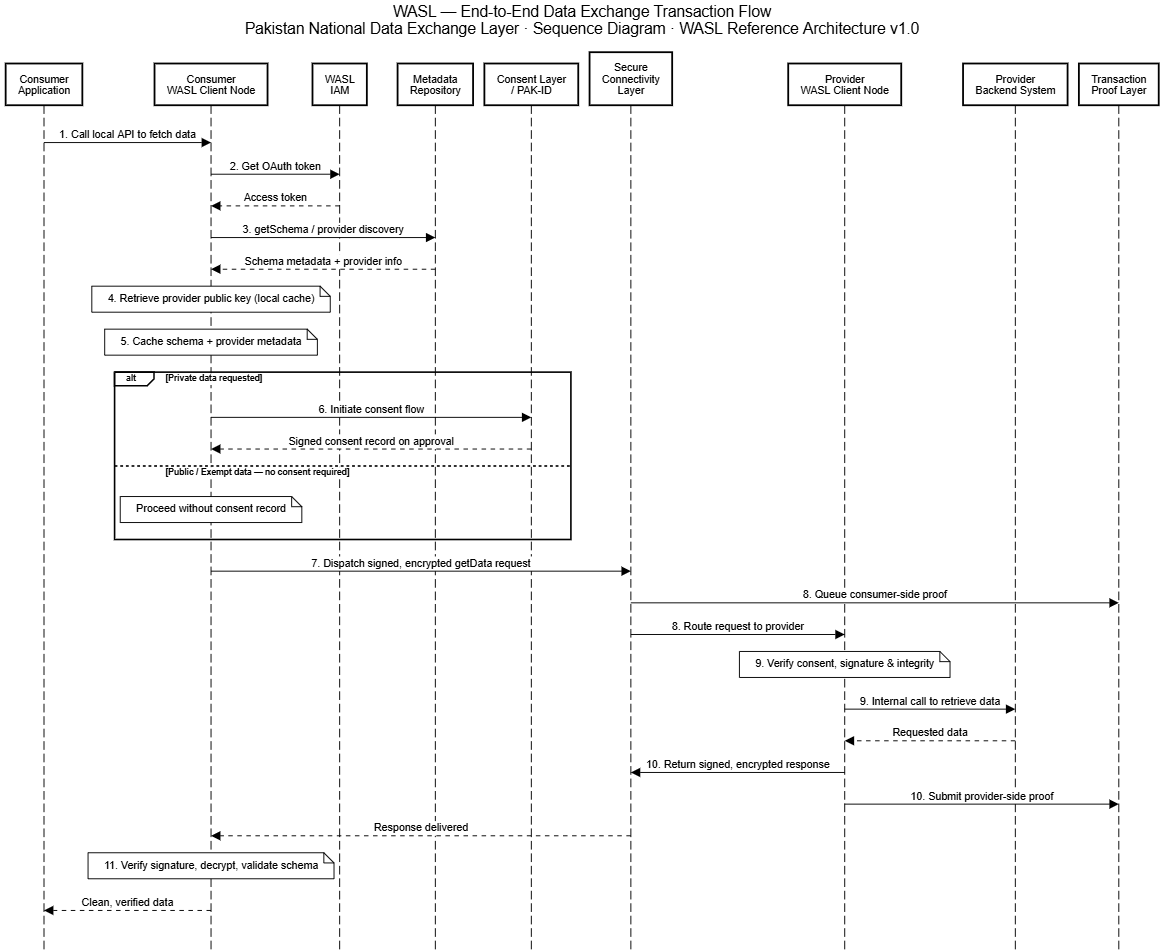
Figure 16-1: WASL End-to-End Data Exchange Transaction Flow, complete lifecycle from consumer request initiation through authentication, metadata discovery, consent handling, secure routing, provider verification, data retrieval, and response delivery This section describes the complete lifecycle of a WASL data exchange transaction from the consumer application’s initial call through to receipt of verified, schema-validated data. Section 16.1 provides the normative summary table; Section16.2 specifies the Secure Connectivity Layer transport envelopes.

Figure 16-2: WASL E2E Encryption and Transaction Signing Flow: Key Derivation, Payload Encryption, Signature Computation, and TPL Recording across Consumer Client Node, WASL Platform, and Provider Client Node (Sections 14.3, 13.3, 15.3)
16.1 Transaction Steps
| Step | Action | Key Technical Operation |
|---|---|---|
| 1 | Consumer application calls local API on its Client Node | Provides subject identifier and dataset ID only; Client Node handles all protocol complexity |
| 2 | Client Node requests OAuth 2.1 access token from IAM | private_key_jwt client assertion; mTLS connection to IAM Token Endpoint |
| 3 | Schema and provider discovery | Client Node checks local cache; calls getSchema if stale; identifies target provider |
| 4 | Retrieve provider public key | From local cache or Metadata Repository; required for payload encryption and response signature verification |
| 5 | Cache metadata locally | Reduces central platform load for subsequent requests |
| 6 | Initiate consent (if data is Tier 4/5) | Consent Layer contacted; citizen notified via PAK-ID; signed consent artifact returned on approval |
| 7 | Assemble and dispatch signed, encrypted request | Consumer generates ephemeral ECDH P-256 key pair; derives session key K1 via HKDF-SHA256 bound to transactionId and datasetId; encrypts payload using AES-256-GCM with K1 and a 96-bit random IV; packages as JWE compact serialisation (RFC 7516; alg: ECDH-ES, enc: A256GCM); signs SHA-256 hash of canonical request body with consumer private key; attaches consent artefact; dispatches via Secure Connectivity Layer. |
| 8 | Route and record (consumer-side) | Secure Connectivity Layer routes to provider; consumer-side proof elements queued for TPL recording |
| 9 | Provider verification and backend call | Fulfilment Layer verifies consumer digital signature; verifies consent artefact platform signature; validates consent status, expiry, scope, and purpose; verifies HKDF context binding (transactionId and datasetId in JWE header must match outer envelope); derives K1 via HKDF-SHA256 from ECDH shared secret; decrypts payload using AES-256-GCM with K1; validates decrypted request against published schema; calls internal backend API. |
| 10 | Provider signs and encrypts response | Response validated against published schema; SHA-256 response hash computed; provider signs concatenation of requestHash, responseHash, and timestamp with provider private key (HSM-protected); response encrypted using same session key K1 with a fresh 96-bit random IV (AES-256-GCM); provider-side TPL proof record submitted to central TPL simultaneously with response dispatch. |
| 11 | Consumer verification | Consumer Client Node verifies provider signature; decrypts payload; validates against schema; returns clean data to application |
16.2 Secure Connectivity Layer: Transport Envelopes
The Secure Connectivity Layer transports the following data for each transaction. Business payloads are encrypted, and the platform cannot read their content.
16.2.1 Consumer Request Transport Envelope
{
  "transactionId": "txn-2026-00001",
  "consumerId": "edu_dept_punjab",
  "providerId": "prov_health_registry",
  "requestDigest": "sha256:abc123...",
  "consentRef": "cons-99821-abcd-ef01",
  "timestamp": "2026-04-18T10:00:00Z",
  "payloadFormat": "encrypted-json",
  "routing": { "protocol": "https", "targetNode": "prov-health-node-01" }
}
16.2.2 Provider Response Transport Envelope
{
  "transactionId": "txn-2026-00001",
  "providerId": "prov_health_registry",
  "consumerId": "edu_dept_punjab",
  "requestDigest": "sha256:abc123...",
  "responseDigest": "sha256:def456...",
  "timestamp": "2026-04-18T10:00:02Z",
  "deliveryStatus": "DELIVERED",
  "payloadFormat": "encrypted-json"
}
Figure 16-2: Layered Transport Security Model, application-level signing and encryption combined with IPSec VPN secure transport channels
17 CONFORMANCE TEST REQUIREMENTS
All WASL Client Node implementations, Central Platform implementations, and Fulfilment Layer implementations SHALL pass the conformance tests defined in this section in the certified WASL sandbox environment before production onboarding is permitted.
17.1 Test Category Summary
| Category | Code | Applicability |
|---|---|---|
| Authentication and Token | CT-AUTH | Consumer Node, Provider Node, Platform |
| Standard API | CT-API | Consumer Client Node |
| Request Envelope | CT-REQ | Consumer Client Node |
| Response Verification | CT-RESP | Consumer Node, Provider Node |
| Consent Handling | CT-CONS | Consumer Node, Provider Node, Platform |
| Schema Validation | CT-SCHEMA | Consumer Node, Provider Node |
| Digital Signature | CT-SIG | Consumer Node, Provider Node |
| End-to-End Encryption | CT-ENC | Consumer Node, Provider Node |
| TPL Recording | CT-TPL | Provider Node, Platform |
| Error Handling | CT-ERR | Consumer Node, Provider Node |
| Event Management | CT-EVENT | Consumer Node, Provider Node |
| Fulfilment Layer | CT-FULFIL | Provider Client Node |
| Delegated Channel | CT-DELEGATED | Sponsoring Entity Client Node, Platform |
17.2 Authentication and Token Tests (CT-AUTH)
| Test ID | Test Name | Expected Outcome |
|---|---|---|
| CT-AUTH-01 | Valid mTLS-bound token acceptance | Request proceeds normally. |
| CT-AUTH-02 | Expired token rejection | HTTP 401 AUTH_TOKEN_EXPIRED. |
| CT-AUTH-03 | Invalid JWT signature rejection | HTTP 401 AUTH_TOKEN_INVALID. |
| CT-AUTH-04 | JTI replay prevention | Second use of same token within expiry returns HTTP 401 AUTH_TOKEN_REPLAY. |
| CT-AUTH-05 | mTLS certificate mismatch | Cert not matching cnf.x5t#S256 returns HTTP 401 AUTH_MTLS_FAILED. |
| CT-AUTH-06 | Revoked certificate rejection | HTTP 401 AUTH_CERT_REVOKED. |
| CT-AUTH-07 | Insufficient scope | HTTP 403 AUTHZ_SCOPE_INSUFFICIENT. |
| CT-AUTH-08 | Unpermitted purpose | HTTP 403 AUTHZ_PURPOSE_MISMATCH. |
| CT-AUTH-09 | Unregistered IP address | HTTP 403 AUTHZ_IP_BLOCKED. |
| CT-AUTH-10 | Clock skew validation | Token with iat > now + 30s returns HTTP 401 AUTH_TOKEN_INVALID. |
17.3 Consent Tests (CT-CONS)
| Test ID | Test Name | Expected Outcome |
|---|---|---|
| CT-CONS-01 | Consent-governed dataset without artifact | HTTP 403 CONSENT_REQUIRED. |
| CT-CONS-02 | Valid consent accepted | Request proceeds; data returned. |
| CT-CONS-03 | Expired consent rejected | HTTP 403 CONSENT_EXPIRED. |
| CT-CONS-04 | Revoked consent rejected | HTTP 403 CONSENT_REVOKED. |
| CT-CONS-05 | Purpose mismatch rejection | HTTP 403 CONSENT_PURPOSE_MISMATCH. |
| CT-CONS-06 | Field scope enforcement | HTTP 403 CONSENT_FIELD_OUT_OF_SCOPE. |
| CT-CONS-07 | Tampered consent artifact rejected | HTTP 403 CONSENT_INVALID. |
| CT-CONS-08 | Consent revocation propagation | getData rejected within 5 seconds of revocation. |
17.4 Signature Tests (CT-SIG)
| Test ID | Test Name | Expected Outcome |
|---|---|---|
| CT-SIG-01 | Valid consumer request signature | Request proceeds. |
| CT-SIG-02 | Tampered request body post-signature | HTTP 400 REQUEST_SIGNATURE_INVALID. |
| CT-SIG-03 | Wrong signing key used | HTTP 400 REQUEST_SIGNATURE_INVALID. |
| CT-SIG-04 | Valid provider response signature verification | Consumer Client Node accepts response. |
| CT-SIG-05 | Tampered provider response | Consumer Client Node rejects — PROVIDER_SIGNATURE_INVALID. |
| CT-SIG-06 | TPL proof signature verification | Caller verifies TPL proof using platform public key. |
17.5 Schema Tests (CT-SCHEMA)
| Test ID | Test Name | Expected Outcome |
|---|---|---|
| CT-SCHEMA-01 | Valid request schema | Request proceeds. |
| CT-SCHEMA-02 | Missing required field (transactionId) | HTTP 400 SCHEMA_VALIDATION_FAILED. |
| CT-SCHEMA-03 | Invalid datasetId format | HTTP 400 SCHEMA_VALIDATION_FAILED. |
| CT-SCHEMA-04 | Unknown datasetId | HTTP 404 SCHEMA_DATASET_NOT_FOUND. |
| CT-SCHEMA-05 | Deprecated schema version | HTTP 410 SCHEMA_VERSION_DEPRECATED. |
| CT-SCHEMA-06 | Provider response schema violation | Consumer receives HTTP 502 PROVIDER_SCHEMA_VIOLATION. |
17.6 Encryption Tests (CT-ENC)
| Test ID | Test Name | Expected Outcome |
|---|---|---|
| CT-ENC-01 | JWE-encrypted request processing | Provider successfully decrypts and processes encrypted request. |
| CT-ENC-02 | JWE-encrypted response processing | Consumer successfully decrypts provider response. |
| CT-ENC-03 | Platform data blindness verification | Platform audit logs contain no plaintext payload data for E2E encrypted transactions. |
| CT-ENC-04 | Ephemeral key uniqueness | Each request uses unique ephemeral key pair. |
| CT-ENC-05 | Wrong provider key rejection | Provider returns DECRYPTION_FAILED for payload encrypted with wrong key. |
17.7 Fulfilment Layer Tests (CT-FULFIL)
| Test ID | Test Name | Expected Outcome |
|---|---|---|
| CT-FULFIL-01 | Complete 12-step verification sequence | All steps performed in correct order; no step skipped. |
| CT-FULFIL-02 | Invalid consumer signature rejected at provider | REQUEST_SIGNATURE_INVALID without calling backend. |
| CT-FULFIL-03 | Schema validation before signing | Non-conforming backend data not returned; PROVIDER_SCHEMA_VIOLATION raised. |
| CT-FULFIL-04 | TPL proof submitted on success | TPL record created with correct hashes and provider signature. |
| CT-FULFIL-05 | TPL proof submitted on failure | Failed transactions recorded with status=FAILED. |
| CT-FULFIL-06 | Backend timeout handling | Provider returns PROVIDER_TIMEOUT if backend exceeds 25 seconds. |
17.8 Conformance Certification Process
To obtain WASL conformance certification, an implementation SHALL: (1) execute all applicable tests in the WASL certified sandbox using the provided test harness; (2) submit test logs and results within 30 days of test completion; (3) resolve all CRITICAL and HIGH severity non-conformances before production onboarding approval; (4) complete a final certification interview; and (5) maintain conformance through re-certification upon each major specification revision.
17.9 Delegated Channel Tests (CT-DELEGATED)
| Test ID | Test Name | Expected Outcome |
|---|---|---|
| CT-DELEGATED-01 | API key/secret exchange for OAuth token | Sponsoring entity-issued API key and secret exchanged via the IAM token endpoint (https://iam.wasl.gov.pk/oauth2/token); scoped delegated_channel token issued with correct delegated_by and delegation_scope claims; subsequent API calls routed through the API Gateway under delegation_scope enforcement. |
| CT-DELEGATED-02 | Scope enforcement — dataset outside delegation_scope rejected | Request for a dataset not listed in delegation_scope returns HTTP 403 AUTHZ_SCOPE_EXCEEDED. Sponsoring entity’s own subscription does not override the restriction. |
| CT-DELEGATED-03 | Scope enforcement — dataset within scope proceeds | Request for a dataset within delegation_scope is routed normally through the API Gateway and Secure Connectivity Layer; response returned to the Delegated Channel application as originating caller. |
| CT-DELEGATED-04 | Missing delegated_by claim on delegated_channel token rejected | Token presenting token_type=delegated_channel without delegated_by returns HTTP 401 AUTH_TOKEN_INVALID at API Gateway. |
| CT-DELEGATED-05 | TPL record captures sponsoring entity identity | TPL proof record for delegated transaction includes both the sponsoring entity org_id (from delegated_by) and the delegated application client_id as distinct fields. |
| CT-DELEGATED-06 | Consent artefact references sponsoring entity, not delegated application | For personal data requests, consent artefact cites the sponsoring entity as the data accessor; citizen notification identifies the entity, not the third-party application. |
| CT-DELEGATED-07 | Province-code routing key resolves correct provider | getData request carrying province_code routing key is dispatched to the matching provincial Client Node; incorrect or absent routing key returns PROVIDER_UNAVAILABLE. |
18 ENTITY ONBOARDING — TECHNICAL REQUIREMENTS

Figure 18-1: Entity Onboarding Lifecycle, the sequential stages required for an organization to become an active participant in the WASL ecosystem
18.1 Onboarding Stages
| Stage | Name | Pre-Requisite | Action Required |
|---|---|---|---|
| 1 | Registration and Approval | None | Yes — multi-level review |
| 2 | Data Sharing Agreement /MoU Execution | Stage 1 | Yes — legal review and signing |
| 3 | PKI Certificate Issuance | Stage 2 | Yes — RA validates identity |
| 4 | VPN Connectivity Establishment | Stage 3 | Yes — NOC validates tunnel |
| 5 | Client Node Deployment | Stage 4 | Technical assistance available |
| 6 | Schema Subscription and API Registration | Stage 5 | Provider schemas reviewed by PDA/NADRA |
| 7 | Sandbox Certification | Stage 6 | Yes — PDA runs conformance tests |
| 8 | Production Activation | Stage 7 | Yes — PDA approves activation |
18.2 PKI Certificate Types
| Certificate Type | Purpose | Validity | Key Algorithm |
|---|---|---|---|
| VPN Device Certificate | IPSec tunnel authentication | 24 months | ECDSA P-256 or RSA-4096 |
| Entity Signing Certificate | Transaction request/response signing | 24 months | ECDSA P-256 or RSA-4096 |
18.3 Registration Payload
{
  "organizationName": "Punjab Education Department",
  "organizationType": "government",
  "federalProvincial": "provincial",
  "province": "Punjab",
  "roles": ["consumer"],
  "authorizedRepresentative": {
    "name": "Ali Khan",
    "designation": "Director IT",
    "email": "ali.khan@edupunjab.gov.pk",
    "phone": "+92-42-XXXXXXXX"
  },
  "technicalContact": { "name": "IT Admin", "email": "it@edupunjab.gov.pk" },
  "intendedDatasets": ["health.immunization","civil.registry.basic"],
  "intendedPurposes": ["school_admission"]
}
18.4 Onboarding Roles
Organizations may participate as: Data Consumer (calls getData to retrieve information from registered providers; subscribes to relevant schemas and generates OAuth credentials); Data Provider (exposes data through the Fulfilment Layer conforming to published schemas; responsible for schema validation of all responses before signing); or both Consumer and Provider simultaneously, with capabilities onboarded separately for each role.
18.5 Sandbox Certification
Before production activation, all implementations SHALL complete certification in the WASL certified sandbox environment using the provided test harness. Sandbox certification covers: API integration against real schema definitions; consent flow simulation; signature and encryption verification; and all conformance tests defined in Section 17. Only after passing all CRITICAL and HIGH severity test categories and receiving the concerned technical team clearance may an entity proceed to Stage 8 (Production Activation). Re-certification is required upon each major specification revision per Section 17.8.
18.6 Stage Narrative
Stage 1: Registration and Approval: Organization registers via the WASL self-service portal providing authorized representative details, legal documentation, role declaration, and technical contact. PDA/NADRA conducts multi-level review with status notifications at each step.
Stage 2: Data Sharing Agreement Execution: Approved organizations execute a formal tripartite DSA/MoU (PDA and NADRA) with terms of use, data handling obligations, SLA commitments, and liability provisions.
Stage 3: PKI Certificate Issuance: The WASL Registration Authority validates entity identity and issues VPN Device Certificates (24-month validity) and Entity Signing Certificates (24-month validity) per Section18.2. Issued only after successful legal onboarding.
Stage 4: VPN Connectivity Establishment: Organization configures its firewall for site-to-site IPSec VPN to WASL’s Secure Connectivity Layer. An NOC validates tunnel establishment, certificate validity, routing, and failover.
Stage 5: Client Node Deployment: Organization deploys official WASL Client Node OCI container images within Kubernetes infrastructure per Section15.1. The Client Node must reside within the organization’s own secure infrastructure boundary.
Stage 6: Schema Subscription and API Registration: Consumers subscribe to schemas via the Developer Portal and generate OAuth credentials. Providers register their domain, configure the Fulfilment Layer, and complete schema review before production publication.
Stage 7: Sandbox Certification: Per Section 18.5 above.
Stage 8: Production Activation: PDA/NADRA approves activation upon successful sandbox certification. The organization is provisioned with production certificates, listed as active in the Provider Directory, and authorized to participate in live WASL transactions.
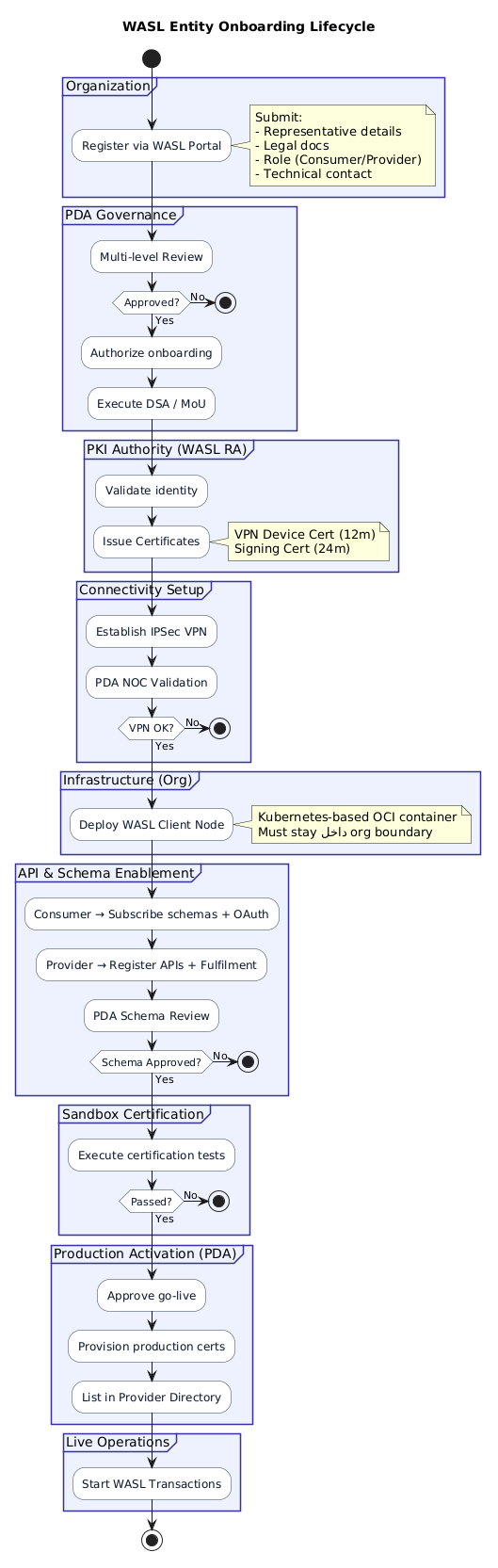
Figure 18-2 WASL - Entity Onboarding Lifecycle, End-to-end process from organizational registration and legal onboarding through PKI provisioning, secure connectivity setup, client node deployment, schema/API enablement, sandbox certification, and final production activation under PDA governance.
19 MONITORING, LOGGING, AND AUDIT: TECHNICAL REQUIREMENTS
19.1 Structured Log Record Schema
{
  "$schema": "https://json-schema.org/draft/2020-12/schema",
  "$id": "https://schemas.wasl.gov.pk/v1/log-record.json",
  "title": "WASL Structured Log Record",
  "type": "object",
  "required": ["logId","timestamp","component","eventType","transactionId"],
  "properties": {
    "logId": { "type": "string" },
    "timestamp": { "type": "string", "format": "date-time" },
    "component": { "type": "string",
      "enum": ["API_GATEWAY","IAM","CONSENT_LAYER","TPL","ORCHESTRATION",
               "SCL","AUDIT","CLIENT_NODE_CONSUMER","CLIENT_NODE_PROVIDER"] },
    "eventType": { "type": "string" },
    "transactionId": { "type": "string" },
    "actor": {
      "type": "object",
      "properties": {
        "type": { "type": "string",
          "enum": ["consumer","provider","platform","admin","citizen"] },
        "id": { "type": "string" }
      }
    },
    "datasetId": { "type": "string" },
    "purpose": { "type": "string" },
    "status": { "type": "string" },
    "errorCode": { "type": ["string","null"] },
    "durationMs": { "type": "integer" },
    "ipAddress": { "type": "string",
      "description": "Masked per data minimisation policy." }
  }
}
19.2 Mandatory Log Events
| Event Type | Component | Required Fields |
|---|---|---|
| TOKEN_ISSUED | IAM | transactionId, actor.id, scope, exp |
| TOKEN_REJECTED | IAM | transactionId, errorCode, reason |
| REQUEST_RECEIVED | API_GATEWAY | transactionId, actor.id, datasetId, purpose |
| CONSENT_VALIDATED | API_GATEWAY | transactionId, consentId, status |
| REQUEST_ROUTED | SCL | transactionId, providerId, routingLatencyMs |
| RESPONSE_RECEIVED | API_GATEWAY | transactionId, providerId, status, durationMs |
| PROOF_RECORDED | TPL | transactionId, requestHash, responseHash, status |
| CONSENT_GRANTED | CONSENT_LAYER | transactionId, consentId, subjectId (masked), channel |
| CONSENT_REVOKED | CONSENT_LAYER | transactionId, consentId, reason |
| ERROR_OCCURRED | Any | transactionId, component, errorCode, detail |
19.3 Log Retention Policy
| Log Category | Retention Period | Encryption at Rest | Access Control |
|---|---|---|---|
| Operational logs | 90 days | AES-256 | Platform operations team |
| Security / audit logs | 3 years | AES-256 | Security & Compliance |
| TPL proof records | 10 years | AES-256 | Read-only for authorised parties |
| Consent logs | 7 years post-consent-expiry | AES-256 | PDA Legal & Compliance |
| Incident logs | 7 years | AES-256 | Security Operations |
20 INFRASTRUCTURE AND DEPLOYMENT SPECIFICATION
20.1 Central Platform SLAs
| Component | Availability SLA | Deployment Model |
|---|---|---|
| API Gateway | 99.9% | Active-Active, multi-AZ; HAProxy/Nginx load balancing |
| IAM Service | 99.9% | Active-Active, multi-AZ; distributed session state |
| Metadata Repository | 99.5% | Active-Passive with hot standby; database replication |
| Consent Layer | 99.5% | Active-Passive; asynchronous replication |
| Transaction Proof Layer | 99.9% read / 99.5% write | Active-Passive write, Active-Active read; eventual consistency acceptable for writes |
| Secure Connectivity Layer | 99.9% | Active-Active; redundant VPN termination |
| Audit and Logging | 99.5% | Append-only, distributed; 7-day minimum local cache |
20.2 Disaster Recovery
| Recovery Time Objective (RTO) | 4 hours for critical services (IAM, API Gateway, SCL) |
| Recovery Point Objective (RPO) | 1 hour for Metadata Repository and Consent Layer; 0 for TPL (synchronous replication) |
| Geographic Redundancy | Primary: Islamabad; DR site: Lahore/Karachi |
| Failover Trigger | Automated for network-level failures; manual approval for data-centre failover |
| DR Test Frequency | Full failover test minimum annually; tabletop exercise quarterly |
21 COMPLIANCE WITH INTERNATIONAL STANDARDS
| Category | Standard | Application in WASL DNP-D.300 TS |
|---|---|---|
| API Standards | OpenAPI Specification v3.0 | All WASL Standard APIs defined per OAS v3.0 |
| API Standards | JSON Schema Draft 2020-12 | All schemas, metadata records, consent artifacts, error responses |
| Authentication | OAuth 2.1 | Token issuance, client credentials grant, scope enforcement |
| Authentication | OpenID Connect Core 1.0 | Citizen-facing authentication via PAK-ID |
| Authentication | IETF RFC 8705 | mTLS client authentication and certificate-bound access tokens |
| Token Format | IETF RFC 7519 (JWT) | Access token structure and all claim definitions |
| Key Infrastructure | IETF RFC 7517 (JWK) | JWKS endpoint and public key distribution |
| Encryption | JOSE RFC 7516 (JWE) | End-to-end payload encryption format |
| Transport Security | IETF RFC 8446 (TLS 1.3) | Mandatory transport encryption; cipher suite requirements |
| Network Security | IKEv2 (RFC 7296) | IPSec VPN tunnel establishment; DH group requirements |
| Digital Signatures | FIPS 186-5 | ECDSA and RSA-PSS algorithm requirements |
| Crypto Modules | FIPS 140-2/3 Level 3 | HSM requirements for entity and CA private keys |
| Information Security | ISO/IEC 27001:2022 | Security management framework |
| Privacy | ISO/IEC 27018 | PII protection in cloud environments |
| Privacy Framework | ISO/IEC 29100 | Privacy framework for consent and data handling |
| Zero Trust | NIST SP 800-207 | Zero trust architecture principles |
| Continuity | ISO 22301 | Business continuity and disaster recovery |
| Timestamps | RFC 3161 | Trusted timestamping for TPL proof records |
22 ORCHESTRATION SERVICES: TECHNICAL SPECIFICATION
Orchestration Services coordinate multi-step, multi-system workflows that cannot be completed through a single API request. They manage state across interactions with IAM, the Metadata Repository, the Consent Layer, the API Gateway, and multiple Provider Nodes to execute complex transactions such as multi-agency eligibility determinations and asynchronous processing flows.
22 Section 22
22.1 Workflow Execution Model
Orchestration Services SHALL execute workflows as state machines where each transaction progresses through defined steps and transitions. Workflow state MUST be persisted including current workflow step; intermediate results (as hashes, not plaintext data); timestamps; transaction identifiers; and error states. A typical orchestrated multi-provider workflow includes validate request; retrieve metadata; initiate consent for all required datasets; fetch data from each required provider; aggregate and validate results; generate signed composite response; and record proof in TPL for all sub-transactions.
22.2 Asynchronous Workflow Support
Orchestration Services SHALL support asynchronous execution of workflows involving multiple systems, external citizen consent, or long processing times. A transaction ID SHALL be returned immediately to the consumer; processing continues in the background; and status is retrievable via the getTransactionTPLStatus endpoint (Section 8.5). This addresses multi-step orchestration flows and is distinct from the single-call async pattern specified in Section 8.6.
22.3 Retry and Failure Handling
Orchestration Services SHALL implement automatic retries with exponential backoff for transient failures; circuit breakers for consistently failing providers; and partial result handling where one provider fails but others succeed. All failures SHALL be recorded in the TPL with status FAILED. If consent expires mid-workflow, the workflow MUST abort and return CONSENT_EXPIRED. If the orchestration service restarts, it MUST resume from the last persisted workflow state.
22.4 Governance Constraints
All data aggregations performed by Orchestration Services MUST: respect the consent scope for each contributing dataset; apply the classification controls of the highest-tier data in the aggregate; and be fully auditable with traceability to each source transaction. Orchestration MUST NOT bypass WASL IAM, consent, or schema validation requirements at any step.
23 SECURE CONNECTIVITY LAYER: TECHNICAL SPECIFICATION
The Secure Connectivity Layer (SCL) is the trusted transport and routing fabric connecting WASL Client Nodes with the Central WASL Platform. It provides the secure communications backbone for synchronous request-response traffic, asynchronous event notifications, consent signaling, and routing metadata. The SCL does not perform consent decisioning, schema validation, access control, or business payload interpretation. Where end-to-end encryption is applied, the SCL transports ciphertext and routing metadata without visibility into the underlying business payload.
23.1 Network Architecture Requirements
All participating entities SHALL connect to WASL through mutually authenticated transport channels: PKI-authenticated IPSec VPN tunnels (IKEv2, AES-256-GCM, DH Group 19 or 20 per Section 5.5); dedicated VPN termination infrastructure at the WASL platform; firewall-enforced ingress and egress controls at both platform and participant boundaries; private or logically isolated routing for WASL traffic; and mTLS at the application layer above the network tunnel. WASL traffic SHALL NOT be routed over unsecured public internet paths.
23.2 Message Routing and Delivery
For synchronous request-response flows, the SCL SHALL: receive a validated request from the API Gateway; resolve the target provider endpoint from the Metadata Repository provider binding; forward the message to the destination Client Node; and return the provider response to the originating path. For asynchronous operations, the SCL SHALL support: at-least-once delivery semantics; retry with exponential backoff; delivery acknowledgment tracking; and dead-letter handling for undeliverable messages.
23.3 SCL Security Controls
The SCL SHALL enforce: mutually authenticated node connectivity using WASL PKI-issued certificates; encrypted network transport (TLS 1.3 at application layer, IPSec at network layer per Section 5); routing only to registered and active Client Nodes per the Provider Directory (Section 9.5); certificate validation and OCSP revocation checking on all connections; and message integrity verification at the transport boundary. These controls complement but do not replace application-layer signing and encryption performed by Client Nodes per Section 14.
23.4 Transport Telemetry
The SCL SHALL generate structured telemetry for: delivery success and failure per node; round-trip latency; node availability; queue depth and backlog; and reconnect and retry events. This telemetry feeds into the monitoring infrastructure (Section 19) and is used for SLA reporting (Section 20.1) and capacity planning.
24 AI INTEGRATION SERVICES: TECHNICAL SPECIFICATION
This section specifies the technical integration requirements for AI systems interacting with WASL, implementing RA Section 12. Two integration patterns are defined: AI in WASL (platform-side AI capabilities operating on metadata and audit streams, never on citizen data content) and AI as a Consumer of WASL (external AI systems invoking WASL APIs as authorized Consumers). All AI interactions are subject to identical authentication, consent, and audit obligations as human-originated interactions, with additional provenance metadata requirements per RA Section 12.3. Governance of AI model lifecycle, evaluation, and safety is defined under the DNP-A series; this section specifies only the WASL integration interface.
24.1 AI Identity Binding: Technical Requirements
When a WASL Client Node is operated by or on behalf of an AI-driven application, the access token issued by IAM SHALL carry the following additional claims (per RA Sections 7.1.1 and 12.2.1): ai_model_id (REQUIRED), the registered model identifier from the DNP-A model registry, format: <registry_code>:<model_identifier>:<version_string>; ai_invoking_principal (REQUIRED), the human operator, service account, or orchestrating system that triggered the AI action; ai_model_version (REQUIRED), the model version string for forensic traceability. These claims SHALL be bound to the token at issuance. Resource servers and the API Gateway SHALL validate their presence for any token carrying ai_model_id. The TPL proof record SHALL capture these values for every AI-originated transaction so that any AI-driven decision can be traced to the specific model, version, and invoking context. AI agents carry no additional data access privileges; access control decisions are made identically on org_id, scope, purpose, and consent artefact as for human-operated requests.
24.2 AI Model Registry Integration
AI-driven consumer applications SHALL register the model(s) they use in the AI model registry under DNP-A prior to production WASL participation. IAM SHALL validate ai_model_id values at token issuance against the registered model list. Tokens referencing unregistered models SHALL be rejected (HTTP 400 AI_MODEL_NOT_REGISTERED). Model deregistration (e.g., following a safety incident) SHALL propagate to IAM within 5 minutes; tokens bound to a deregistered model SHALL be revoked within 15 minutes. These events are mandatory log events (Section 19.2).
24.3 Model Context Protocol (MCP) Integration Surface
WASL exposes an MCP server surface through the Developer Portal (RA Section 12.4), enabling MCP-compatible AI clients to discover WASL schemas, consent requirements, available datasets, and integration patterns through a standardized protocol. The MCP surface does not bypass any WASL security control: MCP clients still obtain IAM tokens, attach consent artefacts, and transit the API Gateway under full enforcement. MCP is a discovery and invocation convenience layer, not a privileged access channel. The MCP server exposes: dataset catalogue discovery (maps to listDatasets API); schema retrieval (maps to getSchema); consent policy inspection (maps to getConsentInfo metadata); and sandbox integration patterns. All MCP tool calls resulting in a WASL API invocation are subject to full TPL recording. The MCP server surface is published at: https://api.wasl.gov.pk/mcp/v1.
24.4 AI Governance Guardrails (Technical Implementation)
Technical implementation of RA Section 12.3 guardrails: (a) No autonomous consent granting, the Consent Layer SHALL reject consent initiation by an AI agent token unless a pre-existing citizen-signed delegated-consent artefact (v2 capability) is present; (b) Parity of audit obligation, the API Gateway SHALL reject tokens carrying ai_model_id without ai_invoking_principal and ai_model_version; TPL records for AI transactions SHALL carry ai_originated=true; (c) No privileged data access — scope and dataset subscription rules apply identically to AI and human operators; no AI-specific endpoint or scope bypass exists; (d) Purpose binding, every AI request is evaluated against declared purpose and consent artefact purpose identically to human requests; (e) Model accountability, bound ai_model_id is required in TPL records enabling post-incident filter by model; (f) Revocability, citizen consent enabling AI access is revocable with immediate effect under Sections 10 and 15.4.
24.5 Delegated-Consent Scaffolding (v1 Structural; v2 Operational)
Per RA Section 12.2.3 and Annex I, WASL v1 includes structural scaffolding for citizen-delegated AI agents (present in schema, not operationally active). The consent artefact schema (Section 10.2) includes reserved fields for delegatedAgentId, delegationScope, delegationPurpose, delegationExpiry, and revocationAddress. Operationalisation requires policy resolution under DNP-A (liability chain, model accreditation, safeguards against agent manipulation) and formal PDA Standards Board decision planned for v2. Until then, requests presenting a delegated-consent artefact type SHALL be rejected (HTTP 501 DELEGATED_CONSENT_NOT_YET_ACTIVE).
25 BILLING AND MONETIZATION: TECHNICAL REQUIREMENTS
Per RA Section 7.1.10, the Central WASL Platform includes a Billing and Monetization component supporting usage-based billing for data exchange. The detailed technical specification is deferred to a dedicated supplement under the DNP-D series. This section establishes the architectural commitments the billing implementation SHALL satisfy.
25.1 Billing Architecture Principles
The billing system SHALL: (a) meter API usage at the transaction level, correlated by transactionId and consumerId from the TPL; (b) support differentiated billing policies by exchange type (government-to-government: free or nominal cost as default per DPI principles; government-to-regulated-private-sector; commercial consumer access); (c) generate automated purchase orders and invoices compatible with Pakistan’s government e-procurement systems; (d) integrate with designated digital payment infrastructure; (e) be data-blind, billing metadata derived from TPL records (entity IDs, dataset IDs, transaction counts, data classification tiers), not payload content; (f) produce billing records independently auditable and reconcilable against TPL transaction records; (g) support Data Provider-specific charging arrangements approved through the Billing Policy process.
25.2 Usage Metering
The metering subsystem SHALL consume TPL proof records as its authoritative source for billable events. Metering counters are maintained per (consumerId, providerId, datasetId, billing period) tuple. Billable events: successful getData calls (status SUCCESS or PARTIAL_SUCCESS); completed asynchronous transactions; event subscription activations/deliveries where applicable under the billing policy. Failed transactions (CONSENT_REQUIRED, AUTH errors, etc.) are not billable. Usage reports available to each Participating Entity through the Developer Portal for the rolling 12-month period. The detailed metering schema, billing policy format, and payment integration specification are published in the billing supplement.
26 DELEGATED CHANNEL INTEGRATION PATTERN
This section specifies the technical requirements for the Delegated Channel integration pattern, the recommended pattern for integrating third-party applications, including Super Apps, composite service platforms, and delegated citizen-facing applications, with WASL. This is an additive capability. It does not modify or override any existing integration pattern, entity onboarding model, or standard API specification in this document. All Participating Entity interactions defined in the preceding sections remain unchanged. The Delegated Channel pattern operates entirely within the existing WASL architecture as defined in DNP-D.002 RA; no RA modification is required.
26.1 Pattern Overview and Rationale
A Delegated Channel application is a third-party platform (such as a government Super App, a private sector composite services portal, or an authorized integration middleware) that acts on behalf of a WASL Participating Entity with explicitly scoped permissions. The sponsoring entity, the Participating Entity that takes responsibility for the delegated application, defines what the application may discover and call, generates the credentials, and remains legally and operationally accountable for all transactions the application performs on its behalf.
The Delegated Channel pattern is the preferred integration approach for use cases that are: state-mutating (requiring an instruction payload to be routed to a provider’s Fulfilment Layer, such as an ownership transfer or a record update); multi-party (involving multiple consent artefacts, multiple agencies, or parallel verification steps); or legally constitutive (where the TPL must anchor the entire transaction lifecycle as a single verifiable record). For such use cases, routing via the API Gateway is mandated because it preserves centralized policy enforcement, automatic TPL capture, and Consent Layer integration without requiring additional bespoke mechanisms at each entity. The API Gateway is the single entry and exit point for all synchronous WASL API requests; requests from Delegated Channel applications are not exempt from this path.
A Delegated Channel application does not require full WASL Participating Entity onboarding (the 8-stage process in Section 18). It does not hold a WASL PKI certificate, does not deploy a Client Node, and is not listed as an independent entity in the Provider Directory. Its authority is entirely derived from and bounded by the sponsoring entity’s permissions. However, Delegated Channel applications SHALL be registered as first-class actors in the WASL ecosystem, recorded against the sponsoring entity’s profile in the Metadata Repository.
26.2 Credential Model: API Key/Secret Issuance and Scoping
The sponsoring entity generates an API key and secret for the Delegated Channel application through the WASL Developer Portal. The API key/secret is a scoped credential; it cannot exceed the entity’s own WASL permissions. The following rules govern issuance and use:
(a) Issuance: the sponsoring entity’s authorized representative generates the API key via the Developer Portal. The key is bound to a declared delegation scope, specifying the dataset IDs and API endpoints the delegated application is permitted to invoke. The scope is a strict subset of the entity’s own dataset_subscriptions and granted scopes.
(b) Token exchange: the Delegated Channel application presents the API key and secret to the WASL IAM token endpoint (https://iam.wasl.gov.pk/oauth2/token) with grant_type=api_key_delegation. Following successful token issuance, all subsequent API calls by the Delegated Channel application are routed through the API Gateway under standard enforcement.
(c) Scope enforcement: the API Gateway enforces delegation_scope on every request. A request for a dataset or endpoint not listed in delegation_scope is rejected with HTTP 403 AUTHZ_SCOPE_EXCEEDED regardless of the sponsoring entity’s own broader subscriptions.
(d) Revocation: the sponsoring entity may revoke an API key at any time via the Developer Portal. Revocation propagates to IAM within 60 seconds. Active tokens bound to a revoked key are invalidated within 60 seconds.
(e) Accountability: all transactions by the Delegated Channel application are recorded in the TPL and audit log under the sponsoring entity’s identity, with the delegated application’s client_id captured as a secondary identifier. The sponsoring entity is the accountable party for all delegated transactions.
26.3 Token Validation for Delegated Channel Tokens
In addition to all standard token validation requirements defined in Section 6.2.4, resource servers and the API Gateway SHALL apply the following additional checks to tokens presenting token_type=delegated_channel:
(a) delegated_by MUST be present and MUST resolve to an active Participating Entity in the Provider Directory;
(b) delegation_scope MUST be present and non-empty;
(c) the requested operation’s required scope MUST appear in delegation_scope (not merely in the sponsoring entity’s subscription list);
(d) the sponsoring entity identified in delegated_by MUST itself hold an active subscription to each dataset in delegation_scope, a scope granted to the delegated application but not held by the sponsor is invalid and the token SHALL be rejected with HTTP 401 AUTH_DELEGATION_INVALID;
(e) mTLS certificate binding applies to the connection between the Delegated Channel application and the WASL API Gateway; the certificate is the Delegated Channel application's own TLS certificate (not a WASL PKI entity certificate); the cnf.x5t#S256 claim reflects this certificate. The API Gateway enforces this binding on every delegated_channel request alongside all standard token validation checks. Token lifetime for delegated_channel tokens is capped at 900 seconds (standard maximum), with shorter lifetimes recommended for high-sensitivity scope sets. The mTLS requirement specified in Section 5.2 applies to all Delegated Channel connections; the API Gateway SHALL verify the certificate thumbprint binding per RFC 8705 on every delegated_channel token request.
26.4 Six-Step Interaction Flow
The Delegated Channel integration pattern operates in two phases: Setup (performed once per application registration) and Transact (performed at runtime for each user workflow).
Setup Phase (Steps 1–2)
Step 1: Entity publishes and approves delegation: the sponsoring entity publishes its APIs and metadata on the WASL platform via the standard metadata publication process (Section 9). The entity then uses the Developer Portal to register the Delegated Channel application, define the delegation scope, and generate an API key/secret pair. The generated credentials are provided to the Delegated Channel application operator through a secure out-of-band channel.
Step 2: Schema and API discovery: the Delegated Channel application uses the API key/secret to call the WASL metadata discovery APIs (listDatasets, getSchema) via the API Gateway. During the initial design-time setup phase, the API key/secret is presented directly to the API Gateway for discovery calls; the API Gateway validates the key, resolves the sponsoring entity, and enforces the declared delegation_scope before returning results. Only datasets and APIs within the declared scope are returned. The application uses the discovered schemas to design and configure its workflow experience. This discovery step MUST route via the API Gateway so that policy-governed scope enforcement applies to discovery as well as to data access. At transaction runtime, a full delegated_channel OAuth token is obtained from the IAM token endpoint before any getData or custom API calls are made (Step 3).
Transaction Phase (Steps 3–6)
Step 3: Token exchange: when a user initiates a transaction, the Delegated Channel application presents its API key and secret to the WASL IAM token endpoint and receives a delegated_channel OAuth token scoped to the declared delegation scope. This applies equally to all parties interacting through the Delegated Channel application, including temporally separated parties such as an initiating party and a responding party in a multi-party workflow; each interaction requires a fresh token carrying the same delegated_by and delegation_scope claims bound to the sponsoring entity. The token is short-lived (maximum 900 seconds).
Step 4: Request submission: the Delegated Channel application constructs a getData or custom API request using the delegated_channel token and submits it to the API Gateway at https://api.wasl.gov.pk/v1/. The API Gateway validates the delegated_channel token per Section 26.3 before routing the request onward.
Step 5: Routing and fulfilment: the API Gateway routes the validated request to the appropriate Client Node via the Secure Connectivity Layer. The primary pattern for Delegated Channel use cases is the sponsoring entity's own published APIs: the entity's Fulfilment Layer receives the request, queries its own backend systems, and returns the response entirely within its own infrastructure boundary.
Where the sponsoring entity is additionally authorized to access another Participating Entity's data through WASL, the sponsoring entity's Client Node may sign and dispatch a getData request to that provider per the standard flow in Section 16; this is a secondary pattern and requires the target dataset to be within the delegated application's declared delegation_scope. All standard requirements apply to this cross-entity getData call without exception: a valid consent artefact is required for any personal data request (Section 10); the target provider's Client Node submits a TPL proof record on every response (Section 13); and the API Gateway enforces token validation, consent validation, and schema compliance on the request before routing it onward. The secondary pattern does not reduce or modify any of these obligations.
Step 6: Response delivery: the response is routed back through the Secure Connectivity Layer and API Gateway to the Delegated Channel application (not to the sponsoring entity's internal systems) because the delegated application is the originating caller.
26.5 Composite Workflow Pattern for State-Mutating Transactions
For state-mutating, multi-party workflows (such as vehicle ownership transfer, property registration, or benefit enrolment) the sponsoring entity SHALL publish the workflow as a single composite endpoint via the Custom API Marketplace (Section 7.3) rather than exposing the individual sub-steps as separate API calls. Internal orchestration is contained within the sponsoring entity’s Fulfilment Layer; the Delegated Channel application sees a single endpoint and a single transaction lifecycle, not the internal sequence of WASL round-trips. This keeps the API Gateway and Secure Connectivity Layer stateless with respect to the workflow and prevents partial-failure complexity from surfacing at the platform layer.
The composite workflow endpoint SHALL implement an explicit transaction state machine. Each state transition is an independent TPL anchor point. The following generic state machine applies to all composite workflow use cases; domain-specific states, transition conditions, and parallel fan-out configurations SHALL be defined in the relevant sectoral Profile (PRF) published under the DNP-D series.
Generic states:
INITIATED: workflow started; all required consent requests dispatched and pending.
VERIFIED: prerequisite checks completed (identity verification, eligibility conditions, or other domain-specific pre-conditions as defined in the applicable PRF); parallel fan-out via Orchestration Services is permitted for independent checks where the dependency graph allows.
PROCESSING: domain-specific fulfilment steps underway; this state accommodates intermediate steps such as payment confirmation, encumbrance checks, regulatory approvals, or other sequential dependencies defined in the applicable PRF.
COMMITTED: all fulfilment steps successfully executed within the sponsoring entity's Fulfilment Layer; final TPL proof record anchored.
FAILED: terminal failure state; permanently recorded; reason code and last-completed state captured in TPL.
Transition rules applicable to all use cases:
Transitions from INITIATED to VERIFIED MAY run concurrently with other non-dependent checks via Orchestration Services parallel fan-out, where the dependency graph permits and as specified in the applicable PRF. Transitions that mutate authoritative records or confirm irreversible external actions (equivalent to a write or payment confirmation) SHALL always be sequential and SHALL not proceed until all preceding states are COMMITTED or VERIFIED as applicable. A FAILED record is never deleted; it serves as permanent evidence of the attempted and incomplete transaction. Partial rollback obligations, where applicable, are defined in the sectoral Profile for the relevant domain.
Domain custodians publishing composite workflow endpoints via the Custom API Marketplace SHALL document the complete state machine for their use case in the applicable PRF, including: all domain-specific states inserted between VERIFIED and COMMITTED; the dependency graph governing parallel versus sequential transitions; timeout and retry parameters per state; and the rollback or compensation obligations on FAILED.
Not all state-mutating workflows require a composite endpoint. Where the sponsoring entity's Fulfilment Layer natively manages workflow state across multiple discrete API calls, and the Delegated Channel application interacts with those APIs sequentially as independent transactions, it is not necessary to publish a single composite endpoint. In this pattern, each API call is an independent WASL transaction with its own TPL record; the workflow state is held entirely within the sponsoring entity's own systems and is not visible to WASL as a unified lifecycle. This pattern is appropriate where the entity's own backend is the authoritative state machine and the Delegated Channel application is a thin caller rather than a workflow orchestrator. The composite endpoint pattern defined above is mandated only where the workflow involves multiple participating entities, multiple consent artefacts collected across parties, or where a single verifiable TPL chain of custody across the full lifecycle is a legal or regulatory requirement.
26.6 Consent Handling for Delegated Channel Transactions
Consent requirements for Delegated Channel transactions are identical to those for standard Participating Entity transactions (Section 10). The following additional rules apply:
(a) Consent notification identifies the sponsoring entity as the data accessor. The Delegated Channel application's name is not presented to the citizen in the consent request. This is consistent with the principle that the sponsoring entity is the accountable party for all delegated transactions: the citizen's legal relationship is with the sponsoring entity, not with the third-party application acting on its behalf. The consent artefact and TPL record fully capture the delegation chain for regulatory and audit purposes, even though the citizen-facing notification presents only the sponsoring entity.
(b) For multi-party workflows requiring multiple consent artefacts (for example, a transaction requiring consent from an initiating party and a responding party), each consent artefact is collected independently through the Consent Layer. The composite workflow endpoint SHALL not proceed to VERIFIED state until all required consent artefacts are active and valid.
(c) Consent artefacts reference the sponsoring entity’s org_id. TPL records capture the full set of consent artefact hashes for the transaction.
(d) Consent revocation applies immediately to all active requests referencing the revoked artefact, consistent with Section 10.
(e) Where a workflow requires consent from multiple parties whose interactions are temporally separated, for example, a transaction initiated by one party and completed by a second party arriving independently at a later time, each consent artefact is collected at the point of that party's interaction with the Delegated Channel application. The workflow MAY proceed through intermediate states on the basis of the first party's consent; steps requiring the second party's consent SHALL be gated on collection and validation of that party's consent artefact before proceeding. Each consent artefact is independently recorded in the TPL with its own hash and timestamp, providing a complete audit trail of when each party authorised their respective step.
26.7 TPL Recording for Delegated Channel Transactions
In addition to the standard TPL proof record fields (Section 13.1), TPL records for delegated_channel transactions SHALL include: delegated_by (the sponsoring entity org_id, from the token claim); delegated_client_id (the Delegated Channel application’s client_id); delegation_scope_used (the specific dataset or endpoint called, as a subset confirmation of delegation_scope); and workflow_state (for composite workflow transactions, the state at which the TPL record was anchored, using the state machine values defined in Section 26.5).
For composite multi-step workflows, the TPL records a proof entry at each state transition, triggered via the Orchestration Services and Fulfilment Layer, creating a complete, independently verifiable chain of custody from INITIATED to COMMITTED or FAILED. The API Gateway and Secure Connectivity Layer remain stateless with respect to the workflow; all state is held within the sponsoring entity's Fulfilment Layer.
26.8 Known Considerations and Mitigations
| Consideration | Mitigation |
|---|---|
| Cumulative latency across multiple sequential WASL round-trips in multi-step workflows | Parallel fan-out via Orchestration Services: prerequisite checks (such as identity verification, eligibility conditions, and domain-specific pre-conditions) dispatched concurrently where the dependency graph permits (Section 26.5). Only terminal steps requiring sequential dependency, as defined in the applicable sectoral Profile, execute sequentially. Latency is bounded by the longest parallel branch, not the sum of all steps. |
| API Gateway and Secure Connectivity Layer used as stateful transaction coordinator beyond their primary routing design | Composite workflows are published as a single endpoint via the Custom API Marketplace (Section 7.3). All internal orchestration state is held within the sponsoring entity's Fulfilment Layer. The API Gateway and Secure Connectivity Layer route individual requests; neither holds workflow state. The Orchestration Services (Section 22) coordinate multi-step dispatch but remain stateless between transactions. |
| Partial failure leaves TPL records in intermediate states requiring reconciliation | The explicit state machine defined in Section 26.5 makes FAILED a first-class terminal state. Each state transition is a distinct TPL anchor. Reconciliation is deterministic: the highest committed state in the TPL chain is the authoritative transaction state. No silent abandonment is possible. |
| Governance overhead if multiple provincial APIs for the same domain are treated as separate publications | Province-code routing key pattern (Section 9.5a): one national schema publication with a routingKeyField covers all provincial providers. Each provincial Client Node registers against the same datasetId with its routingKeyValues. One PDA governance approval; n provider registrations. Approval is not replicated per province. |
Annex A (informative) — Purpose Code Registry
The following example purpose codes can be registered in the WASL Purpose Code Registry. Additional codes are added through the metadata governance process without requiring a revision to this specification.
| Purpose Code | Description | Applicable Datasets (examples) |
|---|---|---|
| credit_assessment | Assessment of creditworthiness for lending | income.tax, civil.registry.basic, land.record.ownership |
| kyc_verification | Know Your Customer identity verification | civil.registry.basic, civil.registry.biographic |
| school_admission | Verification for school enrollment | health.immunization, civil.registry.basic |
| subsidy_eligibility | Eligibility determination for government subsidies | income.tax, land.record.ownership, civil.registry.basic |
| benefits_administration | Social protection benefit administration | civil.registry.basic, income.tax, health.disability |
| insurance_underwriting | Risk assessment for insurance products | health.records, civil.registry.basic |
| legal_verification | Legal proceedings and due diligence | civil.registry.basic, business.registration |
| fraud_detection | Real-time fraud detection and prevention | civil.registry.basic, income.tax |
| employment_verification | Employment background checks | civil.registry.basic, tax.registration |
| regulatory_compliance | Regulatory reporting and compliance | business.registration, income.tax |
| public_service_delivery | Delivery of government services to citizens | civil.registry.basic, health.immunization |
| statistical_research | Anonymized aggregate statistical research (subject to PDA data ethics review) | Any — aggregated and anonymized only |
| law_enforcement | Authorised law enforcement access (statutory basis; subject to judicial oversight) | Any — with judicial authorisation |
Annex B (informative) — Openapi 3.0 Skeleton
The abbreviated OpenAPI 3.0 skeleton for the WASL Standard API is shown below. The complete machine-readable specification is published at https://standards.dnp.gov.pk/DNP-D.300/openapi.yaml.
info:
title: WASL Standard API
version: '1.0.0'
description: Pakistan National Data Exchange Layer Standard API
contact:
email: standards@pda.gov.pk
servers:
- url: https://api.wasl.gov.pk/v1
security:
- BearerAuth: []
mTLS: []
openapi: '3.0.3'paths:
/data/fetch:
post:
summary: getData — Fetch data for a subject
operationId: getData
security:
- BearerAuth: [data.fetch]
requestBody:
required: true
content:
application/json:
schema:
$ref: '#/components/schemas/GetDataRequest'
responses:
'200': { description: Success }
'400': { $ref: '#/components/responses/BadRequest' }
'401': { $ref: '#/components/responses/Unauthorized' }
'403': { $ref: '#/components/responses/Forbidden' }
'404': { $ref: '#/components/responses/NotFound' }
'429': { $ref: '#/components/responses/RateLimited' }
'500': { $ref: '#/components/responses/InternalError' }
components:
securitySchemes:
BearerAuth:
type: http
scheme: bearer
bearerFormat: JWT
mTLS:
type: mutualTLSAnnex C (normative) — Alignment With Dnp-D.002 Ra
This technical specification is subordinate to DNP-D.002 RA (WASL Reference Architecture). The following table maps each RA component and principle to the specific sections of this specification providing the concrete technical implementation requirements.
| RA Element (DNP-D.002 RA) | TS Section (DNP-D.300 TS) | Notes |
|---|---|---|
| Identity and Access Management | Section 6: IAM Technical Specification | OAuth 2.1, OIDC, JWT structure, JWKS |
| OAuth 2.1 / OIDC Protocol Binding | Section 5.3, Section 5.4: Protocol Bindings | Token endpoint, scopes, PKCE |
| mTLS Binding | Section 5.2: mTLS Binding | RFC 8705, certificate-bound tokens |
| IPSec VPN Binding | Section 5.5: IPSec VPN Binding | IKEv2, AES-256-GCM, DH Group 19/20 |
| TLS 1.3 Requirement | Section 5.1: Transport Security | Cipher suites, certificate requirements |
| Standard API Layer | Section 7: Standard API Endpoint Specifications | Endpoint table, HTTP headers |
| Request Envelope | Section 8.1: getData Request Envelope JSON Schema | Complete JSON Schema (Draft 2020-12) |
| Response Envelope | Section 8.2: getData Response Envelope JSON Schema | Complete JSON Schema (Draft 2020-12) |
| Metadata Repository | Section 9: Metadata Record Format | Metadata record JSON Schema |
| Consent Policy Registry | Section 10.1: Consent Policy Format | Consent policy JSON Schema |
| Consent Artifact Model | Section 10.2: Consent Artifact JSON Schema | Consent artifact schema and 10-step validation |
| Data Classification | Section 11: Data Classification Technical Controls | 5-tier classification + controls matrix |
| Error Handling | Section 12: Error Codes and Error Handling | Complete error code registry (40+ codes) |
| Transaction Proof Layer | Section 13: TPL Technical Specification | Proof record schema, signature computation |
| External Anchoring (CT-Log) / Federated Endorsement | Section13.4: External Anchoring (CT-Log); Section13.5: Federated Endorsement Model | Merkle root anchoring process |
| Three-Party Trust / Security | Section 14: Security Architecture | Crypto algorithms, PKI hierarchy, E2E encryption |
| Client Node Autonomy | Section 15: Client Node Technical Specification | Deployment reqs, Fulfilment Layer 12-step sequence |
| Event-Driven Architecture | Section 15.4: Event Management | Subscription format, notification schema |
| End-to-End Data Exchange Flow | Section 16: End-to-End Transaction Flow | 11-step transaction sequence; transport envelopes |
| Conformance | Section 17: Conformance Test Requirements | CT-AUTH through CT-FULFIL test categories |
| Entity Onboarding | Section 18: Entity Onboarding Technical Requirements | 8-stage onboarding; PKI certificate types |
| Audit and Logging | Section 19: Monitoring, Logging, and Audit | Log schema, mandatory events, retention policy |
| Key Management (RA Section 14.2) | Section 14.2a: Client Category Key Management Framework | 4-category risk-differentiated key protection replacing blanket HSM mandate per RA §14.2 |
| Cryptographic Agility and PQC (RA Section 6, Section 14) | Section 14.3a: Cryptographic Agility and PQC Roadmap | Crypto Parameter Registry, Ed25519/ChaCha20, ML-KEM/ML-DSA/SLH-DSA staged roadmap |
| AI Integration Services; MCP (RA Section 12) | Section 24: AI Integration Services Technical Specification | AI identity binding, model registry, MCP surface, governance guardrails, delegated-consent scaffolding |
| Billing and Monetization (RA Section 7.1.10) | Section 25: Billing and Monetization Technical Requirements | Billing architecture, usage metering; detailed billing TS deferred to separate DNP-D supplement |
| Custom API Marketplace; API Gateway; Consent Layer; TPL; Orchestration Services (RA Sections 7.1.3, 7.1.4, 7.1.5, 7.1.6, 7.1.7) | Section 26: Delegated Channel Integration Pattern | Delegated Channel credential model, six-step interaction flow, composite workflow state machine, consent handling, and TPL recording for third-party delegated applications (Super Apps, composite service platforms). No RA modification required; operates entirely within existing RA component model. |
Annex D — Revision History And Forward Compatibility
This Technical Specification is a live document. Publication of a version does not signify that its contents are final or immutable. As WASL implementation progresses, as technology evolves, and as operational experience accumulates, this document will be updated to reflect new requirements, clarifications, and improvements. Revisions are issued in accordance with the PDA Standards Board publication process defined in DNP-X.001 FWK, under which working drafts, pilot drafts, and published versions each carry a defined maturity designation.
However, each published version carries full normative force for the period during which it is current. All Participating Entities, platform operators, and implementers SHALL comply with the requirements of the version in effect at the time of their onboarding and SHALL transition to a superseding version within the transition window specified in that version's release notice. Continued operation under a superseded version beyond its stated transition deadline constitutes non-compliance with WASL participation obligations.
Implementers and Participating Entities are advised to subscribe to PDA update notifications at standards.dnp.gov.pk and to verify they are working from the current published version before commencing or extending any WASL integration. Each substantive revision is recorded in the revision history table below, with a description of the changes made and the approval authority.
D.1 Version History
| Version | Date | Description | Approved by |
|---|---|---|---|
| 1.0 | 18 April 2026 | Initial publication: technical specification |
D.2 Expected Revision Cadence
| Revision Type | Triggers | Backward Compatible? | Migration Period |
|---|---|---|---|
| Minor (e.g., 1.1) | New optional fields, clarifications, additional error/purpose codes | Yes | None required |
| Patch (e.g., 1.0.1) | Corrections, editorial changes, security advisories | Yes | None required |
| Major (e.g., 2.0) | Breaking changes to envelope formats, API signatures, or authentication requirements | No | Minimum 12 months dual-version support |
D.3 Security Advisory Process
Critical security vulnerabilities identified in this specification shall be addressed via an expedited advisory process outside the normal revision cycle. Security Advisories (SA) on the standards portal shall be published, and all registered participating entities directly within 24 hours of a CRITICAL severity finding will be notified.
Bibliography
The following non-normative references support the interpretation and implementation of this Technical Specification. Entries are prefixed "b-" per DNP-X.001 Annex A.6.
[b-1] Pakistan Digital Authority. DNP-D.002 RA — WASL Reference Architecture.
[b-2] Pakistan Digital Authority. DNP-X.001 FWK — Nomenclature, Series Structure, and Issuance Framework (03/2026).
[b-3] UNDP / Office of the UN Secretary-General's Envoy on Technology. The Universal DPI Safeguards Framework, 2023.
[b-4] G20. Framework for Systems of Digital Public Infrastructure, 2023.
[b-5] Republic of Estonia. X-Road Technical Specifications (reference implementation).
[b-6] European Commission. European Interoperability Framework (EIF).
[b-7] IETF. RFC 8446 — The Transport Layer Security (TLS) Protocol Version 1.3, 2018.
[b-8] IETF. RFC 8705 — OAuth 2.0 Mutual-TLS Client Authentication and Certificate-Bound Access Tokens.
Machine-Readable Metadata (JSON-LD)
{
  "@context": "https://schema.org/",
  "@type": "TechArticle",
  "identifier": "DNP-D.300 TS (04/2026)",
  "urn": "urn:dnp:D:300:TS:0.1:en",
  "publishingAuthority": { "code": "PDA", "name": "Pakistan Digital Authority" },
  "title": "WASL — Pakistan National Data Exchange Layer: Technical Specification",
  "titleUrdu": "وصل — پاکستان قومی ڈیٹا ایکسچینج لیئر: تکنیکی تفصیلات",
  "series": "D", "type": "TS", "status": "WD",
  "maturityLevel": "PILOT", "classification": "PUBLIC",
  "normativeReferences": [
    "DNP-X.001 FWK","DNP-D.002 RA","IETF RFC 8446","IETF RFC 8705",
    "OAuth 2.1","OpenID Connect Core 1.0","ISO/IEC 27001","FIPS 140-2/3"
  ],
  "dateApproved": null, "dateEffective": null, "dateReview": "2029-04-26",
  "jurisdiction": "PK", "gazetteReference": "N/A",
  "persistentUrl": "https://standards.dnp.gov.pk/DNP-D.300", "doi": "pending",
  "parentDocument": "DNP-D.002 RA"
}
The following JSON-LD block is the structured metadata record for this publication, as required by DNP-X.001 clause 13. It accompanies the publication package as metadata.jsonld.
Pakistan Digital Authority
4th Floor, 5-A Constitution Avenue, Sector F-5/1, Islamabad 44000, Pakistan
standards (at) pda.gov.pk | https://standards.dnp.gov.pk